
Bully Kicks Black Boy’s Lunch Tray—Too Stupid to Realize He Just Unleashed a Jiu-Jitsu Nightmare in Front of the Whole School
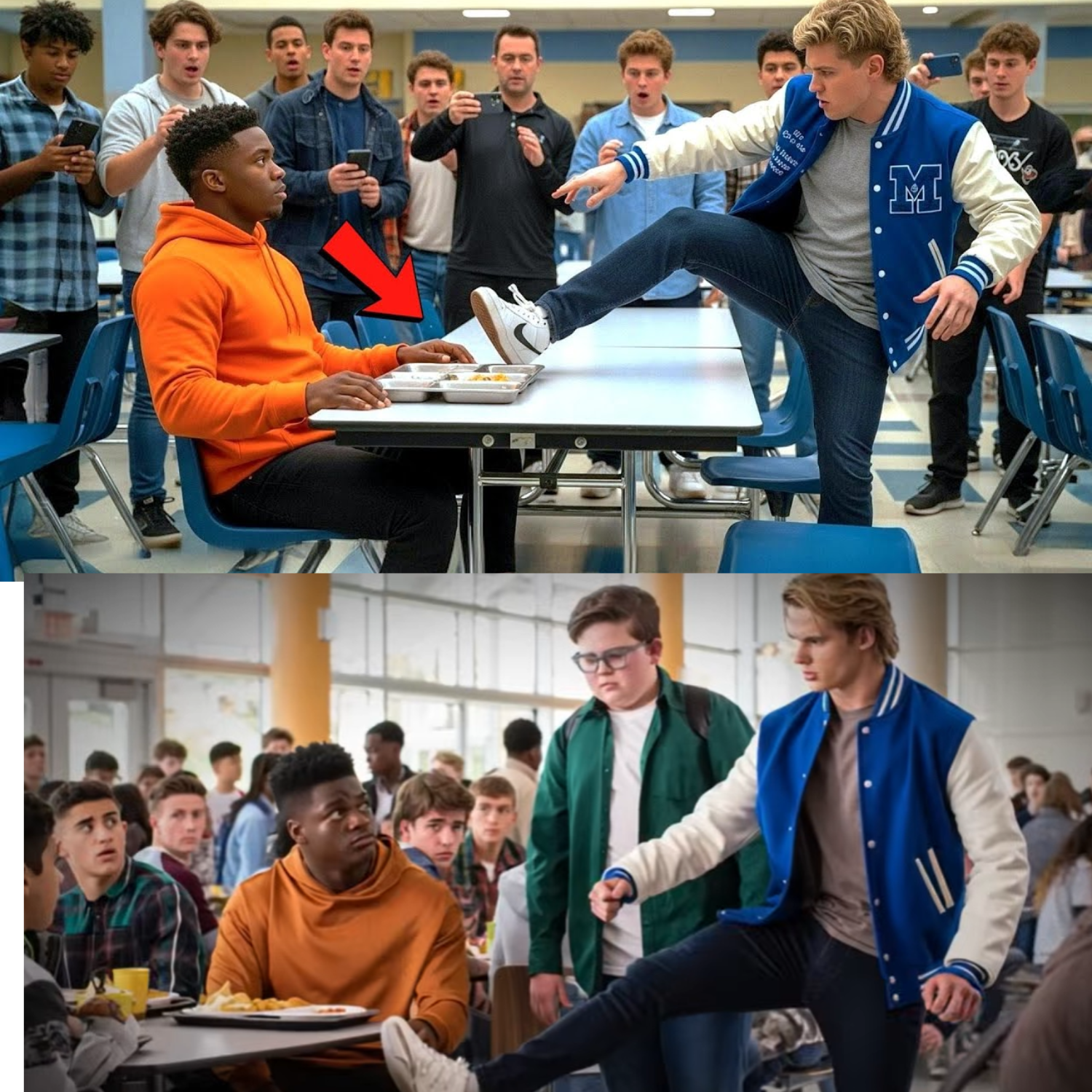
The cafeteria at Ridgeway High was a warzone of noise and adolescent swagger, but nothing could have prepared its students for the spectacle that would redefine the meaning of power, control, and humiliation. It happened in a flash—Dustin’s boot smashed into Luther’s lunch tray, sending mashed potatoes and cheap pizza flying across the tile. The metal tray clattered, food splattered, and for a split second, the entire room froze. Heads turned, mouths dropped, and every eye locked on the corner table where Luther sat, food dripping off his jeans, hands still resting calmly on the table.
Dustin stood over him, smirking, waiting for the reaction every bully craves. He’d spent all week sizing up the new kids, searching for an easy target. Luther, quiet and reserved, was perfect. He didn’t talk much, didn’t laugh at the right jokes, didn’t play the social game. Dustin figured he was just another Black kid who’d keep his head down and take whatever was thrown at him. What he didn’t know—what nobody in that cafeteria knew—was that Luther had spent the last seven years mastering the art of Jiu-Jitsu. He didn’t need words. He didn’t need rage. He was a storm waiting for the right wind.
Chris, Luther’s best friend and unofficial bodyguard, started to rise, fists clenched. But Luther didn’t move. He just stared at the mess, jaw tight, eyes steady. The kind of calm that’s dangerous—the silence before the hurricane. Some whispered, some snickered, but Dustin kept staring down, convinced he’d already won. He was about to learn what it meant to lose.
The morning had started like any other—bells ringing, lockers slamming, students shoving past each other, lost in their own dramas. Luther and Chris, both new to Ridgeway, navigated the chaos with quiet determination. Chris joked about missing their old cafeteria’s mystery meat, but Luther barely smiled. He wasn’t here to make friends; he was here to finish the year and move on. Trouble, however, has a way of finding those who try to stay invisible.
By history class, the tension was thick. Mr. Quinn droned on about ancient battles while half the room stared at the clock. Luther sat in the middle row, head down, copying notes. He didn’t want attention. He just wanted to survive the period without becoming a punchline. But Dustin had other plans. His prank—a talking monkey toy stuffed in Luther’s backpack—set off a wave of laughter. Luther’s face didn’t change, but Chris saw the flicker in his eyes. Something sharp, focused, like a switch flipped inside.
After class, Luther’s calm was even more unsettling. He put the toy away, zipped up his bag, and walked out, movements deliberate, steady. Chris tried to catch his eye, but Luther just said, “I’m fine.” The lie hung in the air. Dustin’s laughter echoed down the hall, a promise that the day wasn’t over.
By lunch, the cafeteria was buzzing. Luther and Chris grabbed their food and found a quiet table in the back. Chris poked at his fries, trying to read Luther’s mood. “You ever notice how people only laugh when they think they’re safe?” Luther asked, voice low. Chris frowned. “What’s that supposed to mean?” Luther leaned back, eyes scanning the room. “Dustin laughs because he thinks there’s no consequence. People like him never stop until they hit a wall.” Chris shook his head. “You’re not that wall, Luther. If you get into it, you’ll just make it worse. Let the teachers deal with it.” Luther’s eyes didn’t waver. “Teachers look the other way. They always do.”
Across the room, Dustin and his crew were loud, tossing glances at Luther’s table and whispering jokes. One mimicked the monkey toy, sending their group into another fit of laughter. Chris clenched his jaw, ready to stand up, but Luther stayed still, gaze locked forward. Dustin caught his stare and raised his drink in a mock toast. “Cheers, buddy!” The cafeteria went quieter, tension thickening. Luther didn’t react. He just went back to eating. That lack of response unsettled Dustin more than a punch ever could.
The bell rang. Students dumped trays and grabbed backpacks. Dustin and his friends lingered, making a show of walking past Luther’s table. Dustin leaned in, voice low: “You think you can ignore me? We’ll see about that.” Luther didn’t reply. He just stared at the crumbs on his tray until their laughter faded down the hall. Chris sighed. “He’s not going to stop.” Luther stood up, voice soft but unyielding. “Neither am I.”
The cafeteria emptied, leaving behind the echo of footsteps and a janitor sweeping up the debris. Luther’s tray lay overturned, a silent testament to Dustin’s failed intimidation. Chris picked it up, cleaned the mess, and watched as Luther reappeared at the entrance. “You could have broken him in half,” Chris said. Luther’s reply was calm: “That’s not the point.”
The second lunch period was when Dustin decided to go for round two. He strutted across the floor, boots echoing, drawing every eye in the room. Even the lunch ladies paused, pretending not to watch. Dustin stopped in front of Luther’s table, towering over him. “Heard you didn’t like my surprise earlier,” he sneered. “Thought I’d give you another one.” Luther met his gaze, eyes cold as steel. “You should walk away.” Dustin laughed. “Scared I’ll hurt your feelings again?”
Without warning, Dustin kicked the edge of Luther’s tray. Metal clattered, food flipped through the air, and the room went dead silent. Chris jumped up, fists ready, but Luther raised a hand, stopping him. “Sit down, Chris.” Dustin tilted his head, mocking. “What? You gonna cry? Do something.”
Luther stood up slowly, chair scraping the floor. He didn’t raise his voice or move fast. He just stood there, staring at Dustin, calm and unshakable. The stillness made Dustin shift, just for a second, like he realized the room felt smaller now. “You think you’re special because you’re quiet. You’re nothing,” Dustin spat.
Luther’s eyes didn’t move. “You should stop talking.” For the first time, Dustin hesitated. The crowd was frozen, the silence pressing down on every chest. Dustin shoved Luther hard, hand against his chest, all his weight behind it. Everyone expected Luther to stumble or swing. What happened next was a masterclass in controlled violence.
Luther shifted his stance, catching Dustin’s wrist in one smooth motion. His movement was quiet, efficient, practiced. With a single turn, he twisted Dustin’s arm down, using Dustin’s own momentum against him. Before Dustin could react, Luther swept his leg out, sending him crashing to the floor with a dull thud that echoed across the cafeteria. Gasps rippled through the crowd. Trays dropped, chairs scraped, students covered their mouths.
Dustin groaned, face twisted in pain and confusion. Luther didn’t follow up—no punches, no yelling. He knelt beside Dustin, holding his arm in a controlled lock, effortless but immovable. “This is what control looks like. Remember it,” Luther said, voice low. He held the position just long enough for the message to sink in, then released him and stepped back.
Dustin stayed on the ground, stunned, eyes wide. His friends didn’t move. Nobody did. It was as if the entire cafeteria forgot how to breathe. Luther straightened his shirt, picked up his chair, and set it back in place. Chris whispered, “You could have broken him.” Luther’s voice stayed calm. “That’s not what it’s for.”
He glanced once more at Dustin, who struggled to his feet, then turned toward the exit. Every step echoed louder than before—a sound that would stick in memory long after it faded. As he reached the door, Luther looked back, not with anger or pride, just silence. That single look carried more weight than any insult or punch ever could. Then he walked out, leaving a room full of students who would never forget how a quiet boy turned humiliation into a lesson nobody dared laugh at again.
After Luther left, the air hung heavy. Dustin sat on the floor, hands pressed to the tile, searching for something solid. His friends shifted awkwardly, trying to laugh it off, but the sound fell flat. Nobody believed the joke anymore. Chris cleaned up the mess, ignoring the stares. When Luther returned, Chris asked, “What was the point?” Luther’s gaze flicked toward Dustin, now pretending to fix his backpack. “To show him what control really means. You can’t teach someone like that with anger. You teach them with restraint.”
Chris exhaled, unsure whether to be impressed or worried. “You think he’ll stop now?” “He’ll think,” Luther replied. “That’s enough.” As they walked down the hallway, students parted for them without a word. The sound of their footsteps echoed against the lockers, steady and even. The cafeteria buzzed with retellings, each student trying to decide whether what they saw was real. Dustin sat alone, replaying every second in his mind. He’d never felt powerless before. What haunted him most was Luther’s face—quiet, patient, unshaken. No hate, no triumph, just certainty. That silence weighed heavier than any punch.
By the final bell, Ridgeway High was changed. The usual chaos was replaced by an uneasy hush. Every whisper circled back to one name: Luther. Some exaggerated, claiming he’d flipped Dustin through the air; others swore he’d barely moved, like he’d shifted gravity for a second. Nobody really knew what they’d seen, but everyone agreed on one thing: Luther wasn’t someone to mess with.
Chris waited by the lockers, watching the stream of students leave. When Luther appeared, stride calm as always, Chris shook his head. “You realize you’re officially a legend now. Half the school’s scared to even look at you.” Luther adjusted his bag. “Fear doesn’t mean respect. It just means they don’t understand yet.”
They walked out together, passing groups of students who lowered their voices. Even teachers seemed quieter, as if the whole building was still processing what had happened. Outside, the city’s noise buzzed faintly. Dustin sat alone on the front steps, elbows on his knees, staring at the ground. His usual crew had vanished. For the first time, he looked small, the weight of what happened finally settling on him.
Luther stopped a few feet away. Chris hesitated, unsure if they should say something, but Luther just looked at him quietly. Dustin didn’t move, didn’t glance up, though he knew they were there. The silence stretched until Chris finally asked, “You think he’s going to come at you again?” Luther shook his head. “No, he’s not angry anymore. He’s just thinking. That’s harder than fighting.”
They started walking home, the world calmer now, as if everything had exhaled. Chris kept glancing at Luther, searching for words. “You didn’t just shut him up. You taught everyone something.” Luther’s reply was low, steady, almost reflective. “Jiu-Jitsu isn’t about fighting. It’s about balance. You win when you stay in control, not when you hurt someone.”
They walked the rest of the way in silence, streetlights flickering on, marking the slow approach of night. Behind them, Ridgeway High stood quiet, holding the memory of a day nobody would forget. Not because Luther fought back, but because he did it without anger—proving that strength isn’t measured by force, but by the peace that follows.
And somewhere inside, Dustin finally understood: the real humiliation wasn’t getting thrown to the ground. It was realizing he’d just been schooled by the quiet kid he thought he could break. The lesson would last long after the bruises faded. And for Ridgeway High, the legend of Luther—the Jiu-Jitsu master who answered hate with restraint—would echo in every hallway, every whisper, every moment someone wondered what real strength looked like.
News
Prison Bully Tried to Humiliate the Black Janitor—Ended Up Flat on His Back While the Yard Watched in SHOCK
Prison Bully Tried to Humiliate the Black Janitor—Ended Up Flat on His Back While the Yard Watched in SHOCK The…
“Bikers Unleash Hell on Bullies Who Tormented a Deaf Kid—And Milbrook Will Never Forget”
“Bikers Unleash Hell on Bullies Who Tormented a Deaf Kid—And Milbrook Will Never Forget” The small town of Milbrook, Ohio,…
“Retired Kung Fu Master Snaps Prison Kingpin’s Ego in Half—Chaos Never Saw It Coming”
“Retired Kung Fu Master Snaps Prison Kingpin’s Ego in Half—Chaos Never Saw It Coming” The moment Elias Brooks shuffled into…
“She Crossed Every Line for a Death Row Prisoner—What He Asked Will Make You Question Humanity”
“She Crossed Every Line for a Death Row Prisoner—What He Asked Will Make You Question Humanity” The clang of steel…
“MAGA Veteran HUMILIATES Jamie Raskin With a Savage Line That Will Haunt Him Forever—Congress Gets Schooled on Real Military Values”
“MAGA Veteran HUMILIATES Jamie Raskin With a Savage Line That Will Haunt Him Forever—Congress Gets Schooled on Real Military Values”…
“Racist Cops Slap Cuffs on Black Female General—Her Pentagon Call Nuked Their Careers and Shattered the Department”
“Racist Cops Slap Cuffs on Black Female General—Her Pentagon Call Nuked Their Careers and Shattered the Department” She said, “I’m…
End of content
No more pages to load