
Billionaire Grandma Sees Black Waitress’s Cheap Necklace—Freezes, Sobs, and Unleashes a $4 Billion Reckoning on Manhattan’s Elite
The diamond pendant caught the light as Margaret Lancaster’s trembling fingers reached out, her voice barely a whisper: “Where did you get this?” In the heart of Dominique, Manhattan’s most exclusive restaurant, time seemed to slow. The young Black waitress, Jasmine, froze mid-step, tray balanced with the silent grace of survival. She had no idea that her $23 necklace—a simple silver heart locket—was about to detonate a scandal that would rip through America’s wealthiest circles and expose secrets buried for nearly three decades.
Margaret Lancaster was not given to emotional displays. At seventy-two, she ruled Lancaster Industries, a $4 billion cosmetics empire, with icy precision. Her silver hair, designer suit, and three-carat diamond earrings were the armor of old money and absolute control. She had buried a husband, outmaneuvered rivals, and never let anyone see her cry. Until today.
Jasmine’s name tag glinted as she stood motionless, Margaret’s gaze locked on the necklace. The pendant was nothing special—a small heart, a tiny engraving on the back. Jasmine had worn it every day since she could remember, the only relic from a past erased by foster homes and group facilities. “Ma’am, I need to take your order,” Jasmine said, voice steady but wary. She’d worked six months at Dominique, saving every penny for nursing school. This job was her lifeline; she couldn’t afford trouble with Manhattan royalty.
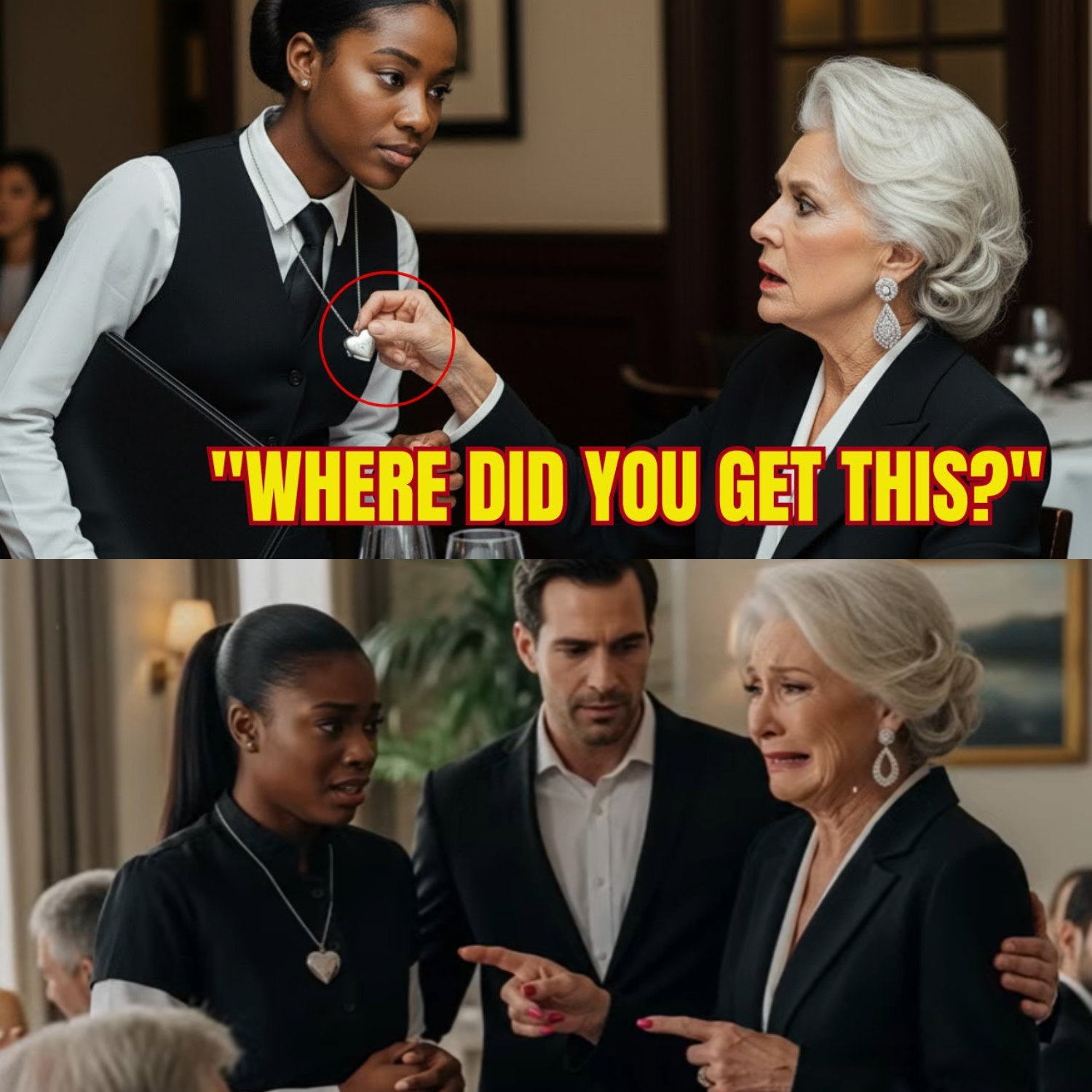
But Margaret didn’t hear her. Her face drained of color as nearby diners began to whisper. Margaret Lancaster, the ice queen of New York society, looked like she’d seen a ghost. “Please,” Margaret begged, voice breaking. “Please tell me where you got that necklace.” Jasmine shifted, feeling the weight of every eye in the room. Her manager, Robert, was already striding over, his face tight with concern. At Dominique, wealthy clients were to be served with silent efficiency—never disturbed, never questioned.
“Is everything all right, Mrs. Lancaster?” Robert asked, inserting himself between billionaire and waitress. Margaret ignored him. “I need to speak with her. Alone.” The restaurant fell silent. Forks hovered, conversations died. Margaret Lancaster was crying—tears streaming down her perfectly made-up face, cutting tracks through her foundation. Jasmine’s heart pounded. She had no idea what was happening. That necklace had been with her since she was found as a newborn, abandoned in a Newark hospital bathroom. It was her only clue to an unknown identity.
Robert tried to steer the conversation to his office, desperate to contain the scene. Margaret stood abruptly, chair scraping on polished floors, and tossed a stack of $100 bills onto the table. “Keep the change,” she said. Turning to Jasmine, she pleaded, “Five minutes of your time. That’s all I ask.” Jasmine looked to Robert, who nodded curtly. Five minutes, in the back office.
The walk through the restaurant felt endless. Every eye followed them, every whisper weighed on Jasmine’s shoulders. She was just a waitress. Margaret Lancaster was royalty. Whatever this was, it couldn’t end well for her.
Inside the cramped office, Margaret closed the door and faced Jasmine, hands shaking. “That necklace,” she began, voice thick with emotion, “I gave it to my daughter 27 years ago.” Jasmine’s world tilted. “I don’t understand,” she whispered. Margaret pulled out her phone, scrolling through photos with trembling fingers. She held up a picture: a young woman, early twenties, laughing, hand on a pregnant belly, wearing a necklace identical to Jasmine’s. “Her name was Caroline,” Margaret said. “My only child.”
Jasmine stared at the photo. The woman looked familiar—or maybe she just wanted her to be. “What happened to her?” Margaret’s face crumpled. “She died in childbirth 27 years ago at a Newark hospital. The baby survived, but Caroline didn’t. I was in Europe. By the time I returned, the agency said the baby was adopted privately. I hired investigators, lawyers—the trail went cold.”
Jasmine’s breath caught. “I was never adopted. I grew up in foster care. They found me in a hospital bathroom, with just that necklace and a blanket.” Margaret’s hope turned to horror. “A bathroom? New York General?” Jasmine nodded. “March 15th.” Margaret pressed a hand to her mouth. “That’s the day Caroline died. Someone took you. Someone at that hospital took you and left you in that bathroom. They stole you from me.”
Jasmine’s tears flowed. “Why would someone do that?” “Because you were worth millions,” Margaret said bitterly. “As my sole heir, you would inherit everything. Caroline wasn’t married; the father was never in the picture. You were my only grandchild. Someone thought they could profit by making you disappear.”
The enormity crashed over Jasmine. She’d grown up with nothing, shuffled between homes where she was just another check from the state. She wore thrift store clothes, ate donated food, worked three jobs to save for community college. All that time, she had a grandmother, a family, a fortune that should have been hers.
“We need proof,” Jasmine said, forcing herself to think. “DNA test. We can do it now,” Margaret replied, her resolve hardening. Within an hour, a private DNA service arrived. Within six hours, results confirmed: Jasmine Torres was Jasmine Lancaster—the missing heir, the stolen baby.
The news broke like a thunderstorm. Billionaire’s missing heir found working as waitress. DNA test confirms restaurant worker is Lancaster Fortune. 27 years later, the mystery of the stolen baby solved. But Margaret wasn’t interested in media frenzy. She wanted justice. She hired the best investigators, demanded hospital records, subpoenaed bank accounts, employment files, old security footage. Slowly, the truth emerged.
It took three weeks to connect the dots: the nurse on duty, the $50,000 deposit, the gambling debts, the mysterious woman who paid for everything—Victoria Ashford, Margaret’s business partner, who needed Margaret distracted to steal from the company and attempt a hostile takeover. Victoria died in a car crash 15 years ago, but accomplices remained. Robert, the manager, had been a nurse at Newark General, paid to make the baby disappear. He tried to run, but Margaret’s security intercepted him at the airport.
In the back of a limousine, Margaret’s rage was ice-cold. “I want names,” she said. Robert broke, spilling everything. Victoria Ashford had orchestrated the kidnapping to destroy Margaret, nearly succeeding. The company suffered, stock prices plummeted, and Margaret nearly lost everything. But she survived, rebuilt, and now, the secrets came spilling out—embezzlement, fraud, conspiracy.
Margaret went after every accomplice. She demanded restitution, criminal prosecution, prison sentences. The DA balked at old crimes, but Margaret used her wealth and influence, hired the best lawyers, generated relentless media pressure. The trial lasted six months. Robert testified for a reduced sentence—he got 15 years. The accountant got 12, the lawyer who falsified adoption records got 10. The hospital paid $20 million for negligent oversight. Everyone who knew but said nothing lost their careers.
But legal victories couldn’t erase 27 years of stolen time. Jasmine couldn’t reclaim the childhood she deserved. Margaret knew this. She focused on the future—bringing Jasmine into her home, her family, her life, not as a replacement for Caroline but as her own person. She paid for Jasmine’s nursing degree at Columbia, introduced her to the company without pressure, and gave her choices for the first time.
Jasmine chose to start a foundation—The Caroline Lancaster Foundation—to reform foster care, ensure no child fell through the cracks as she had. Margaret funded it with $50 million. Within a year, 300 children found permanent homes. Within two years, new laws tightened hospital security and improved newborn tracking. Six months after the trial, Jasmine stood at a podium, wearing a business suit Margaret helped her pick, and around her neck, the simple silver necklace.
“My name is Jasmine Lancaster,” she began, voice clear. “Twenty-seven years ago, I was stolen from my family and left to die in a hospital bathroom. I survived through luck and the dedication of social workers. But I shouldn’t have had to survive. I should have been protected.” The audience listened as she laid out the foundation’s mission—new initiatives, partnerships, training programs, hotlines for reporting child trafficking. “We can’t change the past, but we can shape the future. No other child should experience what I did. No other grandmother should spend decades searching for a stolen grandchild. No other family should be destroyed by greed and cruelty.”
The applause was thunderous. Jasmine did it not for applause, but because Margaret had taught her: Power means nothing if you don’t use it to help others. Margaret watched from the front row, tears streaming down her face—not tears of grief or rage, but pride. Her granddaughter, the baby she thought lost, had survived and thrived. Together, they were changing the world.
Media coverage shifted from tabloid fodder to serious pieces on foster care reform and child protection. Politicians took notice. Donations poured in. Wealthy families started their own initiatives. But the most satisfying moments were quiet ones—when Margaret and Jasmine visited foster facilities and saw children’s faces light up, received letters from reunited families, or sat together in Margaret’s penthouse, looking through old photos of Caroline.
“She would be so proud of you,” Margaret said one evening. “Caroline wanted to help people. She was studying to be a doctor. She had so many plans.” Jasmine squeezed her grandmother’s hand. “Tell me more about her.” Margaret shared stories—Caroline’s childhood, stubborn determination, infectious laugh, terrible cooking. She showed Jasmine videos and letters, making Caroline real—not just a tragedy, but a person.
“I wasted so many years being angry,” Margaret admitted. “After Caroline died and you disappeared, I became cold. I built walls to survive, but those walls kept out joy and love.” “You’re making up for it now,” Jasmine said. Margaret smiled. “We both are.”
The necklace that started everything now hung in the foundation’s headquarters, preserved in a glass case beside Caroline’s photo. The plaque read, “In memory of Caroline Lancaster and every child who survives against impossible odds—may we never forget their worth.” Jasmine wore a replica daily, a reminder of where she came from and where she was going.
Robert, serving his sentence, wrote Jasmine a letter full of apologies. She never responded. Some things couldn’t be forgiven. The other conspirators lost their licenses, assets, and reputations. Jasmine focused on the children she could help, the families she could reunite, the systems she could change.
Her nursing degree included pediatric care. She split her time between a children’s hospital and the foundation. Margaret often joked Jasmine had more energy than her despite being half a century younger. “You got your work ethic from me, but your compassion—that’s all Caroline.”
Lancaster Industries flourished, but Margaret began transitioning leadership to a management team. She wanted time—time with Jasmine, time to make up for lost decades, time to simply be a grandmother. They traveled together—Paris, Tokyo, all the places Margaret had wandered alone in grief, now revisited with joy. In every city, they expanded the foundation, seeking new partners, new programs, new ways to protect children.
The story of the billionaire and the waitress became a movement. Foster care reform became a priority across the nation. Hospital protocols strengthened. Adoption processes improved. Background checks became rigorous. And it all started with a $23 necklace and a grandmother who refused to give up.
Three years after that fateful day, Jasmine introduced her grandmother at a humanitarian awards ceremony. “She is the strongest person I know,” Jasmine said, voice filled with emotion. “She lost her daughter. She lost years with her grandchild. She could have let that destroy her. Instead, she built something beautiful, something powerful, something that will help generations to come.”
Margaret took the stage to thunderous applause, looked at Jasmine, and smiled. “Wealth means nothing if you’re alone. Power means nothing if you don’t use it for good. Family is everything. I’d give every penny I have for those 27 years back. But since I can’t, I’ll spend whatever time I have left making sure no other family suffers as we did.”
When the speech ended, Margaret walked straight to Jasmine and pulled her into a long hug. Photographers captured the moment—the billionaire and the former waitress, the grandmother and granddaughter, two women torn apart by greed and reunited by fate. But fate had a name: Caroline, and a symbol—a necklace that survived 27 years of foster care, waiting for the right moment to bring a family back together.
Share this story if you believe justice can prevail against impossible odds. Hit like if you believe in the power of never giving up. Subscribe for more stories that prove truth and love are stronger than greed. Your story could be next. Never underestimate a grandmother’s love—or the power of a necklace carrying generations’ worth of hope. Justice may take time, but in the end, truth always finds a way. And love never forgets.
News

Prison Bully Tried to Humiliate the Black Janitor—Ended Up Flat on His Back While the Yard Watched in SHOCK
Prison Bully Tried to Humiliate the Black Janitor—Ended Up Flat on His Back While the Yard Watched in SHOCK The…

“Bikers Unleash Hell on Bullies Who Tormented a Deaf Kid—And Milbrook Will Never Forget”
“Bikers Unleash Hell on Bullies Who Tormented a Deaf Kid—And Milbrook Will Never Forget” The small town of Milbrook, Ohio,…
“Retired Kung Fu Master Snaps Prison Kingpin’s Ego in Half—Chaos Never Saw It Coming”
“Retired Kung Fu Master Snaps Prison Kingpin’s Ego in Half—Chaos Never Saw It Coming” The moment Elias Brooks shuffled into…

“She Crossed Every Line for a Death Row Prisoner—What He Asked Will Make You Question Humanity”
“She Crossed Every Line for a Death Row Prisoner—What He Asked Will Make You Question Humanity” The clang of steel…

“MAGA Veteran HUMILIATES Jamie Raskin With a Savage Line That Will Haunt Him Forever—Congress Gets Schooled on Real Military Values”
“MAGA Veteran HUMILIATES Jamie Raskin With a Savage Line That Will Haunt Him Forever—Congress Gets Schooled on Real Military Values”…

“Racist Cops Slap Cuffs on Black Female General—Her Pentagon Call Nuked Their Careers and Shattered the Department”
“Racist Cops Slap Cuffs on Black Female General—Her Pentagon Call Nuked Their Careers and Shattered the Department” She said, “I’m…
End of content
No more pages to load