
“Please Don’t Let Her Speak in Front of the Children”—How One Town Learned the True Meaning of Honor
On Memorial Day in Maple Hill, a small Midwestern town, the mayor’s words were meant to silence a war hero. Instead, they awakened a community—and reminded a nation that respect is never outdated.
.
.
.
A Homecoming Shadowed by Doubt
Rebecca James stepped off the bus at dawn, the weight of her duffel bag and memories heavy on her shoulders. Maple Hill had changed since she left for Afghanistan: flags faded, old stores shuttered, new coffee shops in their place. But the biggest change was harder to see—a subtle shift in what the town valued, and who it chose to honor.
Rebecca, a decorated Army captain and Medal of Honor recipient, had returned at the request of the town council to speak at the Memorial Day ceremony. She almost declined. Public speaking was never her calling, and the title “hero” fit her uneasily. She had lost friends in the war—friends she believed deserved the spotlight more than she ever could.
A Mayor’s Mistake
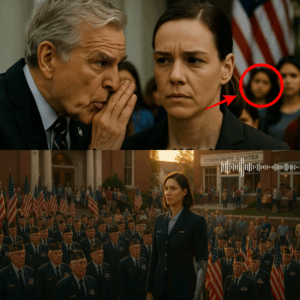
As the ceremony began, Mayor Dalton took the stage. His words were polished, his suit perfect. He spoke of “modern service”—community gardens, environmental work, city planning. All worthy, all important. But then his tone changed:
“We must move beyond outdated ideas of heroism tied to conflict. While we respect our veterans, we must be cautious about glorifying violence in front of our children.”
He leaned in, his voice barely a whisper but loud enough for the front rows to hear:
“Please don’t let her speak in front of the children.”
A hush fell. Veterans straightened in their seats. Parents pulled their children closer. Rebecca sat still, jaw set, as the mayor’s words echoed across the square.
A Veteran’s Response
When her turn came, Rebecca rose quietly. She did not glare at the mayor. She did not raise her voice.
“I’ve heard it said that people like me are outdated,” she began, her voice calm, “that honoring military service sends the wrong message to the next generation. I’m not here to glorify war. No one who’s seen it up close ever would. I’m here because I lost friends I loved like family, and they deserve to be remembered.”
She spoke of her unit in Afghanistan, of defending a girls’ school from Taliban threats. She shared the names of those who did not come home—Michael, Sarah, Damon. She told the story of sacrifice, not for medals or politics, but for the hope that children halfway across the world might have a future.
“Memorial Day isn’t about celebrating conflict,” Rebecca said. “It’s about remembering the people we lost, and asking ourselves why we remember them.”
When she finished, the silence was profound. Then, one by one, veterans stood. The crowd followed. Applause grew from a ripple to a wave. Rebecca simply nodded and returned to her seat, humility her only armor.
A Town Awakens
That evening, a video of the mayor’s words and Rebecca’s speech went viral. Hashtags trended: #HonorIsNotOutdated, #LetHerSpeak. Veterans from neighboring towns organized online, and by sunrise, more than 400 stood in silent formation on the steps of city hall—no signs, no chants, just the weight of medals, memories, and silent respect.
Mayor Dalton arrived late, stunned by the wall of veterans. One handed him a photo: Rebecca kneeling beside a wooden cross in Afghanistan, surrounded by Afghan girls placing flowers in memory of her fallen friend. On the back, a simple note: “The girls still visit every year.”
Rebecca’s words were soft but clear: “Now you know what honor looks like.”
A New Beginning
The mayor apologized—publicly and privately. He admitted his ignorance and asked Rebecca to help reopen the town’s shuttered veterans’ center. She agreed, on one condition:
“It can’t be about saving face or legacy. It has to be about service. And not just military service—community, education, mentorship. We serve in many ways.”
Months later, the Maple Hill Veterans and Service Center opened its doors. Inside, veterans mentored youth, organized food drives, and offered support to those struggling with PTSD. On the walls were not just photos of war, but of service—volunteers, teachers, caregivers, neighbors helping neighbors.
Rebecca’s Medal of Honor sat on her grandfather’s mantle, surrounded by photos of those she served with and for. She didn’t run the center, but she shaped its heart.
A Lasting Lesson
Maple Hill changed. Kids interviewed veterans for school projects. The high school added a service-learning course. Sunday services thanked not just soldiers but nurses, teachers, and postal workers. The town learned that service is not defined by uniform or rank, but by sacrifice—by showing up, even when there’s nothing left to gain.
The mayor changed, too. He listened more, spoke less, and brought his daughter to volunteer at the center.
Rebecca’s story is not just about a confrontation or a viral video. It’s about quiet dignity, about standing for others when no one is watching, about honoring those who serve in every way.
As her grandfather once told her, “True service never ends. It just finds new forms.”
What Does Service Look Like to You?
In a world that moves fast and often forgets, Rebecca’s story is a reminder:
Service isn’t outdated. Respect is never out of style. And sometimes, the greatest acts of honor happen not in the spotlight, but in the silence that follows.
How do you define honor in today’s world? Who in your life deserves to be remembered?
News

Heartbreaking: Hulk Hogan’s Last Wish Revealed—You Won’t Believe His Ultimate Regret!
Hulk Hogan’s Final Tragedy: Wrestling Icon Dies Estranged from Family, Never Meeting His Grandchildren July 2025 – The world of…
Astronomer Hires Gwyneth Paltrow—Her EPIC Response to Chris Martin’s Controversy!
Gwyneth Paltrow’s Ultimate Power Move: How She Turned Her Ex-Husband’s Joke Into Tech’s Most Brilliant PR Stunt Boston, 2025 In…

Leaked Footage SHOCKS Fans: Kristin Cabot & Billionaire Andy Byron in Hot Water After Coldplay Kiss Cam!
The $38 Million Kiss: How a Viral Coldplay Concert Clip Sparked the Most Expensive Scandal in Tech History Boston, July…

Melania BETRAYS Trump: Epstein Bombshell DROPS at the WORST Possible Moment!
Melania’s Revenge: Will Trump’s Wife Be the Ultimate Betrayer in the Epstein Scandal? She Was Never Loyal—And Now the Truth…

Elon Musk EXPOSES Trump’s Criminal Secrets—Ghislaine Coverup UNRAVELS LIVE!
When Justice Is for Sale: The Maxwell Gambit, Trump’s Power Play, and America’s Crisis of Truth Washington, August 2025 —…

King Charles SHOCKS Trump & Melania With LIVE TV Bombshell—Watch Trump Explode!
The Final Unraveling: Trump’s Epstein Inferno Reaches the Palace Gates August 2025, London/Washington — The wildfire of the Epstein scandal…
End of content
No more pages to load