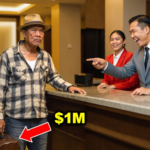
They Tackled a 92-Year-Old Veteran — Then Black SUVs Blocked the Entire Street
In a small Vermont town where the past lingers quietly in every brick and every breeze, a single act of remembrance became the spark that forced a nation to stop and look at itself.
.
.
.
A Promise Carried for a Lifetime
Arthur Green, 92, was never one for attention. He lived alone above a shuttered barbershop, his most prized possession a folded American flag given to him by Helen Whitmore—the sister of his best friend and fallen comrade, Corporal Thomas Whitmore. Every year, for over four decades, Arthur walked the same slow path to the town’s modest war memorial, laying the flag beneath a granite pillar and tending a rose bush he’d planted for the dead.
To most, Arthur was just the old man with the limp and the flag, a relic of wars most people only read about in textbooks. But to Arthur, that flag was a promise—a memory of a brother lost at the Chosin Reservoir, a sacred duty never to let the world forget.
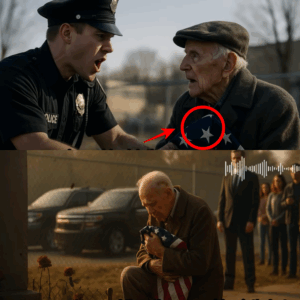
Progress vs. Memory
But now the memorial was threatened. The city council, under pressure from a wealthy developer, planned to bulldoze the park and shrink the monument to a decorative afterthought, paving over the rose bush and the memories it represented. For the few aging veterans left in town, it felt like a final erasure.
On the morning demolition was set to begin, Arthur made his pilgrimage as always. The park was fenced off, bulldozers looming, a red sign screaming “Danger: Demolition Zone.” Arthur, unbowed, found a gap in the fence and approached the memorial—flag in hand, resolve in his heart.
A Clash at the Fence
Officer Ryan Rand, young and eager, confronted him. “You’re trespassing,” he barked, grabbing Arthur’s wrist. When Arthur tried to explain, the officer twisted his arm behind his back, forcing him to his knees. The flag slipped from Arthur’s grasp and landed in the dirt. Passersby watched, some filming, others muttering about laws and rules. Arthur, humiliated and in pain, tried to reach for the flag one last time.
That’s when everything changed.
Black SUVs, a Town Holds Its Breath
A deep, unfamiliar rumble rolled down the street—three black SUVs, moving with purpose and authority. Doors flew open. Out stepped a man in a tailored suit, silver hair, posture straight as a parade ground. Without a word, he knelt beside Arthur, recognition and pain flickering in his eyes.
“Arthur Green, is that really you?” the man asked.
It was Colonel Marcus Langford, a decorated commander, the son of the very man Arthur had tried to save in Korea all those years ago.
Langford’s voice cut through the tension. “Unhand him. Now.” The officer hesitated, but the command was absolute. Langford gently lifted Arthur, picked up the flag, and turned to the crowd.
The Story Behind the Flag
With the street silent, Langford told the story: how Arthur had saved his father’s radio operator at Chosin, how he had carried the flag for decades, honoring not just his friend but all who served. “He never asked for recognition,” Langford said. “He asked only for remembrance.”
Veterans in the crowd removed their hats. Mothers whispered to their children. The town, for the first time in years, listened.
A Viral Reckoning
By midday, video of the incident had gone viral. Headlines blared:
“Medal of Honor Recipient Detained by Police While Honoring Fallen Comrade.”
Public outrage was swift. The mayor’s office promised an investigation. Veterans groups across the country called for accountability. Within days, the redevelopment plan was suspended, the memorial’s land protected forever.
Officer Rand was reassigned and made a public apology. The city installed new benches and a bronze plaque at the memorial:
“To those who served, and to the ones who remembered, even when the world forgot.”
A Town Remembers
In the weeks that followed, the memorial became a gathering place again. Not just for veterans, but for families, students, and strangers—people who brought flowers, flags, and stories. Arthur kept walking to the memorial, slower now, but never alone. Colonel Langford visited often, not as a commander, but as a friend.
Arthur never wanted fame. He never asked for his name to be on the plaque. He just wanted the memory to live on.
What Will We Remember?
Arthur Green’s story isn’t just about a confrontation at a fence. It’s about the quiet dignity of those who carry history with them, and the responsibility of a community to honor that history before it’s too late.
In our rush for progress, do we pause to remember the people and promises that built our world? Or do we, like so many, wait for a moment of shame to remind us what we should have seen all along?
As you walk through your own town, ask yourself: Who are the Arthurs among us? Whose stories have we missed? And will we honor them now, while they’re still here to see it?
Because sometimes, it takes a single act of quiet courage—and a nation finally paying attention—to remind us what remembrance really means.
News

Heartbreaking: Hulk Hogan’s Last Wish Revealed—You Won’t Believe His Ultimate Regret!
Hulk Hogan’s Final Tragedy: Wrestling Icon Dies Estranged from Family, Never Meeting His Grandchildren July 2025 – The world of…
Astronomer Hires Gwyneth Paltrow—Her EPIC Response to Chris Martin’s Controversy!
Gwyneth Paltrow’s Ultimate Power Move: How She Turned Her Ex-Husband’s Joke Into Tech’s Most Brilliant PR Stunt Boston, 2025 In…

Leaked Footage SHOCKS Fans: Kristin Cabot & Billionaire Andy Byron in Hot Water After Coldplay Kiss Cam!
The $38 Million Kiss: How a Viral Coldplay Concert Clip Sparked the Most Expensive Scandal in Tech History Boston, July…

Melania BETRAYS Trump: Epstein Bombshell DROPS at the WORST Possible Moment!
Melania’s Revenge: Will Trump’s Wife Be the Ultimate Betrayer in the Epstein Scandal? She Was Never Loyal—And Now the Truth…
Elon Musk EXPOSES Trump’s Criminal Secrets—Ghislaine Coverup UNRAVELS LIVE!
When Justice Is for Sale: The Maxwell Gambit, Trump’s Power Play, and America’s Crisis of Truth Washington, August 2025 —…
King Charles SHOCKS Trump & Melania With LIVE TV Bombshell—Watch Trump Explode!
The Final Unraveling: Trump’s Epstein Inferno Reaches the Palace Gates August 2025, London/Washington — The wildfire of the Epstein scandal…
End of content
No more pages to load