
“I Can Fix It.” A Homeless Black Man Hears a Billionaire’s Cry for Help—Then He Schools Him in Genius, Justice, and Everything Money Can’t Buy
Smoke poured from the engine of the $4.2 million Quantum Apex hypercar, painting the air with blue-gray streaks of failure in a forgotten industrial district. Tech titan Anthony Wright, founder of Nexus Innovations, stood beside his dying status symbol, frantically dialing every number in his phone. No one answered. The crowd grew. The proprietary engine—unfixable outside the factory, according to the manufacturer—continued its death rattle. Anthony’s reputation, and a crucial investor pitch three hours away, was about to go up in smoke.
“Don’t touch my car,” Anthony snapped at the homeless black man approaching, not knowing this stranger was about to save his hypercar—and shatter everything he believed about genius, worth, and judgment.
“Sir, your quantum thrust cooling system has a micro fracture in the secondary loop,” said the man, hands raised in peace. “I can fix it.”
Anthony’s finger hovered over the security number. How could this man possibly know about technology so classified that even the manufacturer wouldn’t acknowledge it existed? What hidden genius was standing before him? Why was he living on the streets?
Thomas Johnson hadn’t always been invisible. Three years ago, he was a legend: MIT graduate, three engineering degrees, seven patents, designer of cooling systems that transformed aerospace and saved lives. Then came the fall—false accusations, corporate politics, a gap in employment history, and the unspoken prejudice of being a black man from the wrong side of town. Now, Thomas slept under the open sky, folded his tarp with military precision, and kept his mind sharp by reading discarded tech journals and teaching science to kids at the homeless shelter.
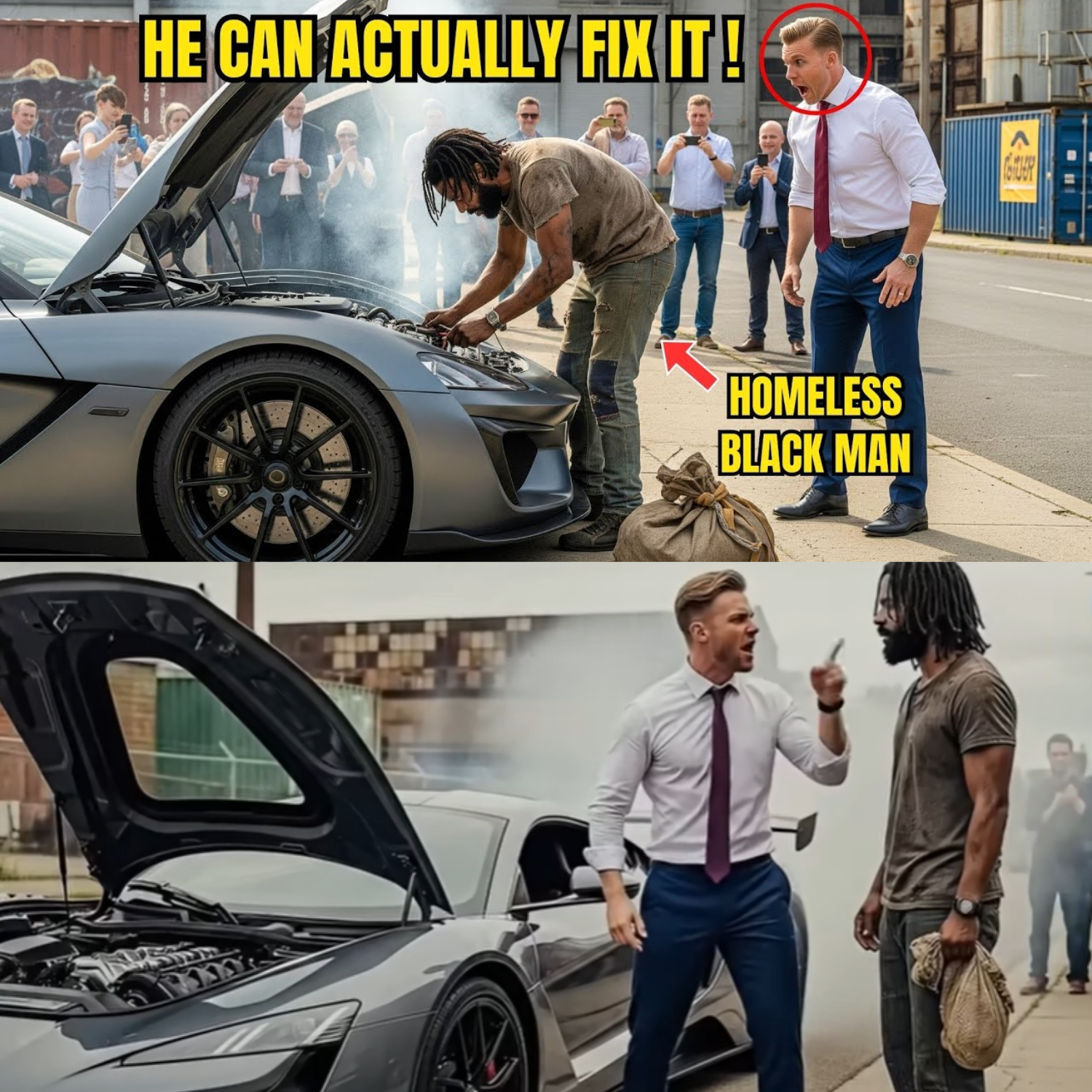
He’d noticed the Quantum Apex’s unique purr for weeks, recognizing the engine he’d helped design. He knew the micro fracture would develop in the exact spot he’d flagged in his original blueprints—a flaw ignored by executives desperate to meet deadlines. Now, one of those executives stood before a smoking monument to Thomas’s disregarded expertise.
Anthony’s hand tightened around his phone, eyes flickering with recognition—not of Thomas as a person, but as a threat. Thomas knew that gesture well. He’d seen it countless times. What Anthony couldn’t know was that Thomas had once been invited to present at the same tech conferences where Anthony was a keynote speaker. Their paths had nearly crossed before Thomas’s world imploded.
The tech world forgets vindication but never scandal. Thomas watched the smoke pattern, diagnosing the problem with a glance. He could fix it with basic tools and knowledge the current engineering team didn’t have. Maybe it was pride, maybe hope, but Thomas remained a problem-solver at heart.
“Step back from the vehicle, please,” Anthony said, not looking Thomas in the eye. Onlookers doubled, phones out, recording the spectacle of a billionaire stranded beside his dying hypercar. “Sir, I really can help,” Thomas persisted. “That model has a known issue with the quantum thrust cooling system, secondary loop.”
“How would you know anything about this car?” Anthony cut him off, eyes scanning Thomas’s worn clothes and grocery bag. Dismissal was immediate.
“Because I helped design the prototype cooling system it’s based on.”
A burst of laughter escaped Anthony, echoed by the crowd. “Right. And I teach rocket science at community college.”
Anthony turned away, but Thomas continued. “The fracture is causing coolant to leak into the tertiary chamber, which is why you’re getting that specific shade of blue-gray smoke. Catastrophic engine failure in 47 minutes.”
Anthony froze. The diagnostic system had given him a 45-minute warning. “How did you—” Suspicion flared. “Is this a stunt?”
Security guards arrived, eyeing Thomas with professional suspicion. “Is there a problem, Mr. Wright?”
“This gentleman was just leaving,” Anthony replied.
“I know the Quantum Apex uses a modified Aerotech cooling system,” Thomas said quickly. “Internal memo XT447 documents the exact issue.”
Anthony’s face flickered with recognition. That memo was never public.
“How do you know about that?”
“Because I wrote it,” Thomas replied. “Five years ago, consulting engineer at Aerotech. My name is Thomas Johnson.”
Anthony’s skepticism warred with curiosity. “What would you need to fix it?”
“Basic tools. Most are in your emergency kit. Twenty minutes of uninterrupted work.”
Security checked Thomas’s ID—just a shelter card. No address, no job, some “incident” at his last employer. Anthony’s face hardened. “My team will handle this.”
But fate wasn’t done. Anthony’s phone rang—roadside assistance was two hours away, his meeting couldn’t be rescheduled, and the smoke was thickening. “Sir, perhaps we should clear the area if there’s a risk of fire,” suggested a guard.
“There won’t be a fire,” Thomas said calmly. “The real concern is microscopic damage to the quantum thrust bearings—$870,000 to replace, eleven weeks lead time.”
“How do you know the exact cost?”
“I helped calculate the specs.”
Anthony’s options dwindled. “Show me. Tell me exactly what’s happening and what you’d do.”
Thomas explained the three-tier cooling system, pinpointed the leak, and described the workaround: using the emergency kit’s sealant and graphite from a specific pencil to create a temporary fix.
“You’re going to fix my hypercar with pencil lead?”
“Yes. Engineering is about solving problems with available resources.”
The crowd quieted, sensing the tension. Anthony checked the time—28 minutes to failure. He reached for the hood release. “Let’s see what you can do.”
With the hood open, Thomas worked methodically, his hands betraying years of expertise. He identified the micro fracture, explained its impact, and prepared the repair. Suddenly, another security chief arrived, warning about industrial espionage. “We can’t allow unauthorized access to proprietary tech.”
“I’m not just anyone,” Thomas replied. “And we have 18 minutes before irreversible damage.”
Anthony hesitated, reputation and millions at stake. “Perhaps we should wait for the manufacturer.”
“In 15 minutes, it’ll be too late,” Thomas said, dignity intact.
A guard confirmed Thomas’s genius with the shelter coordinator. The diagnostic system chimed—12 minutes to failure.
“Call Dr. Eleanor Chen at SpaceTech Industries,” Thomas said. “She’ll confirm everything.”
Anthony called. Dr. Chen’s response was immediate: “Thomas Johnson is the most brilliant thermal engineer I’ve ever worked with. If he says he can fix it, let him.”
Anthony looked at Thomas with new eyes. “If you’re who she says, how did you end up like this?”
“False accusations, racial profiling, a system quick to condemn and slow to exonerate. Try getting back up with no address, no phone, no credit score.”
Anthony nodded, chasened. “Finish the repair.”
Thomas mixed the sealant and graphite, applied it with surgical precision, vented the contaminated coolant, and restored pressure. The crowd watched as he performed technological surgery.
“Start the engine,” Thomas instructed. Anthony hesitated, then obeyed. The hypercar purred to life. No smoke. Diagnostic: “System stabilizing. Performance limited to 70%.”
A cheer erupted. Anthony stared in disbelief. “The manufacturer said this couldn’t be done.”
“They overcomplicate things to maintain their monopoly,” Thomas replied.
“How long will this hold?”
“Three weeks under normal use. Schedule proper service. Keep output below 70%.”
Anthony extended his hand. “Thank you.” Thomas accepted, composed.
But Anthony wasn’t done. “Join me at my investor meeting. Your insights would be invaluable.”
“I’m hardly dressed for it.”
“We’ll fix that.” Anthony called ahead for professional attire. For the first time, Thomas smiled. “That might be worth seeing.”
In thirty minutes, Thomas emerged transformed—tailored suit, trimmed beard, commanding presence. Anthony nodded. “Now you look the part.”
“Appearances are deceptive,” Thomas replied. “That’s the point, isn’t it?”
At Nexus headquarters, employees stopped to stare at the commanding stranger. Anthony introduced Thomas to Sophia Reyes, CTO. Recognition flashed. “Your work was revolutionary.”
Anthony explained, “Thomas just saved my car with pencil lead.”
Sophia laughed. “That’s brilliant. Why didn’t we think of that?”
“Sometimes the simplest solutions are overlooked,” Thomas suggested.
In the investor meeting, Thomas listened to the presentation on quantum thermal regulation, then spoke for seven minutes—identifying three critical flaws, proposing elegant solutions, and sketching a modification that increased efficiency by 34% while reducing costs. The room fell silent, then erupted in questions. Investors committed to increased funding on the spot.
Anthony closed the door, awestruck. “You didn’t just improve our design. You transformed it.”
“I appreciate the offer, but I’m not sure consulting is what I need,” Thomas replied.
“Director of engineering. Creative control.”
“It’s not about titles,” Thomas said. “It’s about addressing the larger issue—how many brilliant minds are wasted by circumstances beyond their control.”
Anthony listened as Thomas described an innovation center for talent recovery—a place to identify and nurture overlooked genius. “These patents I developed while homeless could fund the initial phase. I want us to build it together.”
Not revenge, not just personal redemption—systemic change.
Anthony extended his hand. “Thomas Johnson, you’ve found a partner.”
The patents Thomas had sketched on discarded newspapers were worth more than the hypercar he’d just saved. But their true value lay in the transformation they sparked in an industry that had nearly lost one of its greatest minds. Brilliance appears in unexpected places, often dismissed by superficial judgments and systemic bias. The true measure of society isn’t in the success of the privileged, but in our ability to recognize and nurture genius wherever it exists.
This story isn’t just about Thomas and Anthony. It’s about everyone who’s ever been overlooked, underestimated, or dismissed. The next world-changing idea might come from the person society taught you to ignore.
If this story moved you, subscribe to Beat Stories. Share your experience. The next moment of extraordinary justice might be yours.
News
Prison Bully Tried to Humiliate the Black Janitor—Ended Up Flat on His Back While the Yard Watched in SHOCK
Prison Bully Tried to Humiliate the Black Janitor—Ended Up Flat on His Back While the Yard Watched in SHOCK The…

“Bikers Unleash Hell on Bullies Who Tormented a Deaf Kid—And Milbrook Will Never Forget”
“Bikers Unleash Hell on Bullies Who Tormented a Deaf Kid—And Milbrook Will Never Forget” The small town of Milbrook, Ohio,…
“Retired Kung Fu Master Snaps Prison Kingpin’s Ego in Half—Chaos Never Saw It Coming”
“Retired Kung Fu Master Snaps Prison Kingpin’s Ego in Half—Chaos Never Saw It Coming” The moment Elias Brooks shuffled into…

“She Crossed Every Line for a Death Row Prisoner—What He Asked Will Make You Question Humanity”
“She Crossed Every Line for a Death Row Prisoner—What He Asked Will Make You Question Humanity” The clang of steel…
“MAGA Veteran HUMILIATES Jamie Raskin With a Savage Line That Will Haunt Him Forever—Congress Gets Schooled on Real Military Values”
“MAGA Veteran HUMILIATES Jamie Raskin With a Savage Line That Will Haunt Him Forever—Congress Gets Schooled on Real Military Values”…

“Racist Cops Slap Cuffs on Black Female General—Her Pentagon Call Nuked Their Careers and Shattered the Department”
“Racist Cops Slap Cuffs on Black Female General—Her Pentagon Call Nuked Their Careers and Shattered the Department” She said, “I’m…
End of content
No more pages to load