
“Tinukso ng Tsina ang mga Sundalong Pilipino🇵🇭 – Ngunit Ang Nangyari Sunod ay Nagsalita sa Kanilang Katahimikan!”
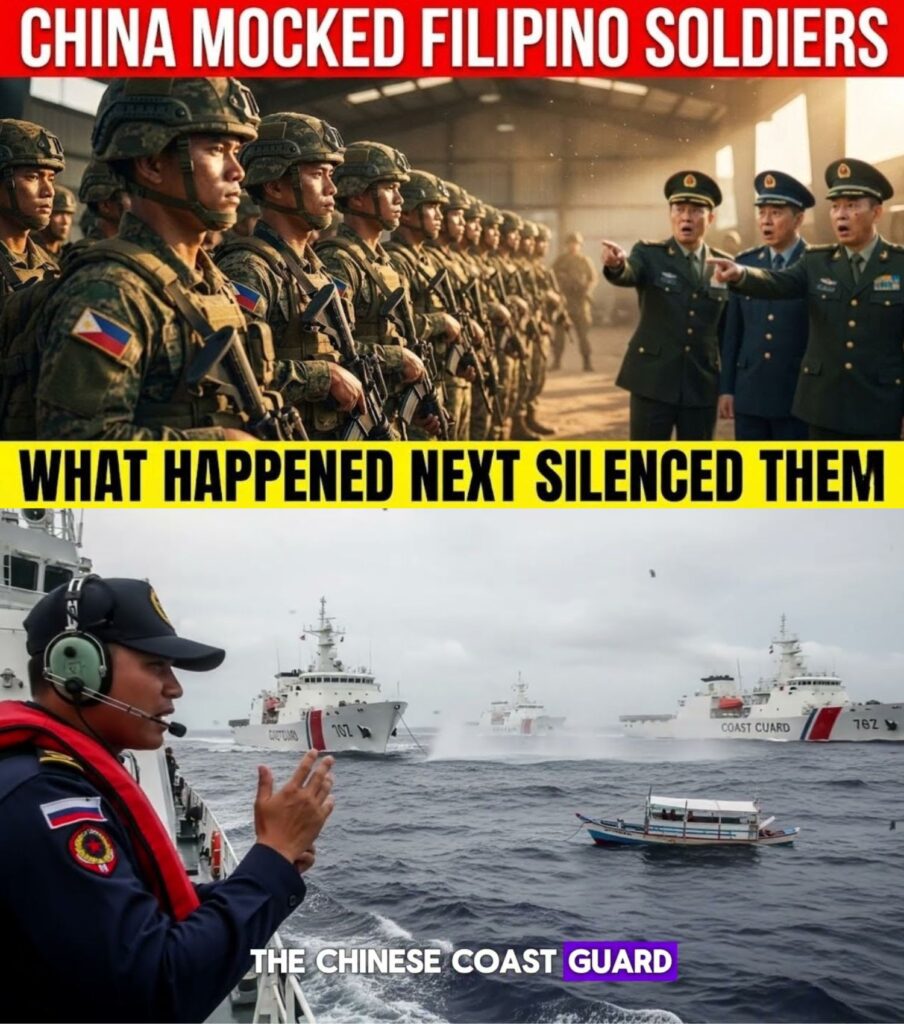
There are moments in history when a nation’s soul is tested, not by the size of its army, but by the depth of its courage.
This is the story of one such moment.
Not the moment you see in documentaries with slow-motion jets and dramatic music. Not the moment captured in carefully edited speeches or diplomatic communiqués. This moment started with a smirk in a brightly lit room in Beijing… and ended with twelve soaked, exhausted Filipino men standing under a tattered flag on a rust-eaten outpost in the West Philippine Sea, proving to the world that you don’t have to be big to stand tall.
Welcome back to TIT Tales. Today isn’t about bar scams, retirees in Pattaya, or love stories gone wrong. Today is about something much older, much deeper: the question every small nation faces when a bigger one leans over the fence and says, “Move.”
Do you kneel?
Or do you dig your feet into the sand and whisper, “Kaya pa”?
It began with a press conference.
The briefing room in Beijing was as cold and clean as a surgical theater. Fluorescent lights hummed softly above rows of journalists, cameras lined up like artillery. At the front stood a high-ranking Chinese general in a stiff, perfectly pressed uniform. His chest was a small museum of medals and ribbons, each one catching the light when he moved.
He’d been through dozens of briefings like this. Most were routine. Threat analysis, defense spending, “regional stability.” Words stacked like bricks to build the impression of inevitability: we are big, we are strong, everything we do is destiny.
But that day, one question slipped through the cracks.
“General,” a foreign correspondent asked in careful Mandarin, “what do you make of the Philippines’ continued assertion of territory in the South China Sea—what they call the West Philippine Sea?”
The general’s lips curled. Not in anger, not in caution, but in amusement.
“The Filipinos?” he repeated.
A low, polite chuckle rippled through the room. Everyone sensed something was coming.
He shook his head, the way a man might when a child insists he can lift a sofa.
“They are too small to fight,” he said casually. “Too weak to resist. Like children trying to push against a mountain.”
The room laughed. Cameras whirred. Pens scratched. It was a perfectly shaped soundbite: dismissive, quotable, guaranteed to trend.
The clip was on Chinese social media within minutes.
It was on Philippine social media within hours.
From Manila to Tokyo, from Hanoi to Washington, people watched that chuckle, that little twist of contempt at the corner of his mouth, over and over again.
“The Filipinos? Too small to fight. Too weak to resist.”
Memes exploded. Some Filipinos responded with jokes—a coping mechanism as old as colonization. Others responded with rage. Hashtags trended; outraged commentaries filled YouTube and TikTok. Old footage of Filipino soldiers in the Korean War, in World War II, in Marawi resurfaced, spliced side by side with the general’s smirk.
But far from Manila’s noise, far from the scrolling and sharing and subtweeting, in a rust-streaked outpost hammered into a lonely reef in the West Philippine Sea, a group of Marines watched the clip on a cracked phone screen with patchy signal and battery at 11%.
They weren’t in a mood to make memes.
They weren’t about to write long threads.
They watched the general’s chuckle, the effortless dismissal of their country, their uniforms, their lives.
Lance Corporal Juan “JR” Reyes squinted at the screen. He was twenty-three, with sunburned cheeks and salt-crusted hair, the kind of kid who should’ve been worrying about job interviews and weekend barkada trips, not gray hulls on the horizon.
“Lumakas pala tayo ah,” he said dryly. “From maids and call centers to children pushing mountains.”
The other Marines chuckled, but there was very little humor in it.
Sergeant Eduardo “Doy” Manalo, older, broader, with the permanent squint of a man who’d spent too many years staring at sun-struck seas, took the phone from him. He replayed the clip, watching the general’s face closely, as if searching for something beneath the mockery.
The signal froze on the smirk.
“Anak ng…” Doy muttered, then stopped himself. He exhaled, handed the phone back, and turned his eyes seaward, toward a horizon that belonged to nobody and everybody, claimed by ink on maps and sweat on decks.
He didn’t rage.
He didn’t post.
He simply took a breath and went back to checking the corroded railing along the edge of the outpost, making sure it would hold under the next storm.
Because he knew something that general, for all his medals, had clearly forgotten.
Courage isn’t measured in meters, or tons, or number of ships.
It’s measured in how far you’re willing to go when everyone expects you to run.
Two days later, orders came.
They were printed on plain paper and transmitted through the chain of command with the same routine precision as a payroll document. But everyone who touched those orders felt the weight in the simplicity.
SUPPLY MISSION – AYUNGIN OUTPOST
VESSEL: BRP DATU KALANTIAO
CREW: 7 NAVAL, 5 MARINE
OBJECTIVE: REPLENISH FOOD, WATER, FUEL, MEDICAL SUPPLIES
THREAT LEVEL: HIGH
Ayungin Shoal. Second Thomas Shoal. A name with multiple labels, because that’s what happens when more than one nation insists something is theirs.
But for the twelve men of the BRP Datu Kalantiaw, it wasn’t about maps or Hague rulings or diplomatic notes. It was about the men on that tilted, rusting outpost who were living off carefully rationed water and canned goods.
Without that supply run, those men would go hungry.
Without that supply run, the flag nailed to a makeshift mast above that grounded hull would flutter over an empty deck.
The Datu Kalantiaw waited in harbor like a tired warrior pulled out of retirement.
She was not a sleek frigate with radar domes and vertical launch systems. She was a weathered wooden-hulled vessel, a hybrid of fishing boat, patrol craft, and stubbornness, patched more times than anyone cared to count. Her paint peeled in long, curling strips, revealing older layers beneath: blues, whites, grays, the ghosts of previous assignments.
Her engine was loud but dependable. Her weapons consisted of a couple of mounted machine guns, small arms, and whatever resolve her crew carried in their chests.
Captain Miguel “Mike” Santos stood on the dock, looking at his ship.
He was forty-one, with salt-and-pepper hair and lines at the corners of his eyes that came from both squinting at sun-glare and worrying about his children. He’d joined the Navy at eighteen, survived storms, mechanical failures, and more than one close pass with bigger ships flying different flags.
He had heard the general’s words, watched the clip on a lagging government office computer three hours after everyone else.
Too small. Too weak.
He’d laughed once, quietly, not because it was funny, but because it was so familiar. He’d heard versions of it his whole life.
Too small to be varsity.
Too poor to be picky with jobs.
Too brown, too provincial, too whatever.
He’d spent his life politely proving people wrong. This mission would be no different.
His crew assembled in front of him on the dock: seven sailors in faded blue, five Marines in worn camo. Some were veterans. Some still had faces that looked wrong under a helmet, like they’d borrowed their father’s uniform for a school play.
He cleared his throat.
“Brothers,” he said, voice steady. “The world is watching.”
They shifted, glancing at each other. A seaman at the back swallowed.
“Not because they expect us to win,” he continued, “but because they expect us to run.”
The youngest Marine, JR Reyes, couldn’t help it. The question burst out of him like a bubble he’d been holding too long.
“Sir… what if they ram us?”
Everyone heard the unspoken words: What if the stories are true? What if the videos we’ve seen—water cannons, blocked supply runs—happen to us?
Captain Santos looked at him for a long moment. In that silence was everything: the knowledge that their ship was outmatched, that their weapons were almost symbolic, that their families were waiting at home watching news tickers and praying rosaries.
His eyes softened with something between sadness and pride.
“Then we swim,” he said quietly. “But we don’t turn back.”
No one cheered. This wasn’t a movie. They nodded, some more nervously than others.
Behind them, on the pier, a small crowd had gathered. Families. Girlfriends. Wives. Children waving hand-drawn flags made of bond paper and crayons. One little boy—about six—held a piece of cardboard with a crooked sun and three stars scribbled in yellow and blue.
“Tatay!” he shouted, his voice crackling above the gulls and engines. “Tatay, picture muna!”
One of the sailors, Petty Officer Ramon “Mon” Villanueva, broke ranks, jogged over, knelt, and hugged his son so tightly the boy squeaked in protest.
“Ang higpit, Tay!” the boy laughed, wriggling.
Mon kissed his forehead. “Makinig ka kay Mama, ha?” he said. “Pagbalik ni Tatay, bili tayo ng Jollibee.”
“Promise?” the boy asked, eyes wide with a seriousness only kids have about fast food.
“Promise,” Mon said.
He stood, eyes suspiciously bright, and jogged back into line.
Small promises, big stakes.
As dawn broke, painting the sky in gold and crimson, the Datu Kalantiaw’s engine rumbled to life. The rope was cast off. Gap widened between hull and pier.
On the dock, hands waved.
On deck, hands waved back.
Twelve men sailed toward a storm no one wanted to see—but everyone needed to witness.
The first hours were deceptively calm.
The sea glistened under a bright tropical sun, the water a sheet of blue broken only by the ship’s wake and the occasional flying fish. The wind was steady. Radios crackled with routine updates.
Inside the cramped cabin, the helmsman, Seaman First Class Joel “Jo” Dizon, kept his eyes on the horizon, hands steady on the wheel.
“Parang picnic lang, Cap,” he said after a while, trying to lighten the mood. “Baka naman fake news lang lahat. Baka wala naman sila sa area.”
“’Wag kang mag-joke ng ganyan,” Sergeant Doy muttered, leaning against a bulkhead. “Baka marinig ng multo.”
“What ghost?” Jo grinned. “Chinese ghost? South China Sea ghost?”
“Ghost of common sense,” Doy replied. “Kasi nawala nung pumayag tayong sumakay dito.”
They laughed, the kind of half-forced laughter that humans use to keep the dark away.
On the upper deck, JR Reyes stood near the bow, filming the open sea with his phone. He’d started a Facebook Live mostly to give his family something to see beyond dry text messages.
“Mga kababayan,” he said into the camera, trying on the host voice he’d heard on countless vlogs. “Ayun po, Palawan na iiwan natin. Papunta na kami sa Ayungin. ’Wag kayong mag-alala, babalikan namin kayo.” He tried to laugh, but his eyes betrayed the tension.
Viewers were few at first. Mostly relatives. A tita in Dubai. A cousin in Cavite.
“Mag-ingat kayo dyan, Junjun!” one comment read. Only titas and mothers still used his childhood nickname.
As the hours passed and the boat pushed deeper into contested waters, the mood shifted. The jokes thinned. The silence grew heavier.
And then, like sharks scenting blood, they appeared.
“Contact, Captain,” Jo said suddenly, voice tight. “Multiple returns. Starboard side.”
Santos stepped closer, eyes narrowing at the radar. Three blips. Large. Moving fast.
He lifted his binoculars, squinting against the shimmer of noon sun on water.
There they were.
Three white hulls, distant at first but growing with every passing second. Clean lines, big numbers, gray decks. Coast Guard, but built like warships. Each one over 10,000 tons, dwarfing the Datu Kalantiaw like trucks bearing down on a tricycle.
They moved with mechanical precision, slicing through the water, adjusting course in silent choreography.
Jo swallowed hard. “Parang… tatlong condo na may makina, Cap.”
On deck, the Marines and sailors crowded to one side, watching. Conversations died mid-sentence.
It’s one thing to talk about “Chinese gray hulls” in abstract.
It’s another to see them, looming, real, angled bows pointing at you like accusing fingers.
The radio crackled to life, a crisp voice cutting through static in heavily accented English.
“Philippine vessel,” it said. “This is China Coast Guard. You are entering Chinese territorial waters. Turn back immediately or face consequences.”
The words were familiar. They’d been heard by fishermen, by other supply ships, by foreign reporters. A script repeated over and over, as if repetition could manifest ownership.
Captain Santos picked up the handset, pressed the button. His hand did not shake.
“Negative, China Coast Guard,” he replied calmly. “This is a Philippine government vessel operating in the West Philippine Sea, within the Exclusive Economic Zone of the Republic of the Philippines under international law. We will proceed with our mission.”
A pause. Then a different voice came on, this one less clipped, more amused.
“Philippine vessel,” it said, “you think you can challenge us with that… fishing boat?”
Laughter followed—short, cutting, broadcast over radio waves as if the entire ocean deserved to hear how funny their defiance was.
On deck, Jr’s phone captured the moment, the rolling Chinese accent, the disdain.
Comments began to stack faster on his live feed.
“Grabe, naririnig natin ’yung boses nila.”
“Solid kayo, mga sir. Ingat kayo.”
“Mga anak ng bayan, saludo kami!”
JR lifted the phone, catching his own face for a second—jaw clenched, eyes dark. He turned the camera outward, toward the white hulls that now flanked them like silent chalk cliffs.
Captain Santos didn’t answer the mockery. He simply met Jo’s eyes.
“Full speed ahead,” he said.
“Full speed” on the Datu Kalantiaw wasn’t much. The engine coughed, growled, and the boat strained forward, pressing every horsepower it had into the churning sea.
The Chinese ships adjusted effortlessly, swinging into new positions. One slid in front, blocking the direct path to the outpost. The other two moved alongside, slightly ahead, forming a narrowing corridor—a funnel with steel walls.
Water cannons swiveled, thick nozzles turning like the eyes of mechanical beasts toward a much smaller prey.
“Cap…” Mon said quietly, watching. “Ayun na.”
The first blast hit before any of them could properly brace.
There was no warning siren, no countdown. Just a sudden roar and a white wall of water, as solid and unforgiving as a fist, slamming into the Datu Kalantiaw’s bow.
The ship shuddered violently. Supplies lashed to the deck broke loose, crates banging against each other. Men grabbed for railings, boots sliding on suddenly slick wood.
JR’s phone jerked wildly. For a second, the live feed showed nothing but sky and spray and a jumble of curses.
“Capitan, we’re taking in too much water!” Jo shouted. He could barely be heard over the roar.
Santos tasted salt and metal. His world narrowed to the wheel in his hands and the feel of his ship underfoot.
“Bail it out!” he yelled. “We keep moving!”
Another blast. This one from the port side, shearing across the deck, knocking a Marine to his knees. A cooler went skidding, smashed against the rail, spilling water bottles that rolled like marbles.
“Bucket brigade!” Sergeant Doy barked automatically, decades of training snapping into place.
Marines and sailors grabbed whatever they could—actual buckets, cut-off plastic jugs, even helmets. They formed a chain, scooping water from the low sections of the deck and hurling it back into the sea, just as another wave crashed down on them.
JR pressed his back against a bulkhead, phone in one hand, bucket in the other. The live stream saw everything: the chaos, the shouting, the raw determination on faces streaked with seawater and sweat.
The viewer count in the corner of the screen ticked upward faster and faster.
Three hundred.
Three thousand.
Thirty thousand.
The algorithm smelled drama and pushed the feed into timelines and For You pages across the Philippines and beyond.
In Quezon City, a jeepney driver parked by the side of the road, handing his phone to his passengers so they could all watch.
In Cebu, a call center floor went quiet as agents took a “bathroom break” at the same time and huddled around screens in the pantry.
In Hong Kong, a Filipina domestic worker on her day off sat on a park bench, tears mixing with her Starbucks as she watched kids in uniform get slammed by industrial-grade water.
In Riyadh, oil workers in blue jumpsuits gathered in a dormitory common room, the desert outside their window a world away from the angry gray waves battering their kababayans.
The comments exploded.
“Lord, protect them.”
“Wala kayong armas pero may puso kayo, mga sir!”
“China bully!!!”
“Stand strong, Pilipinas!”
“Watching from Tokyo, we stand with you!”
On the Datu Kalantiaw, none of that mattered. The internet was another universe. Their world was the slippery deck under their boots, the sting of salt in their eyes, the ache in their arms as they passed bucket after bucket.
Another blast. The boat tilted, dangerously this time. For a sickening heartbeat, Santos felt the deck roll beneath him, the horizon tilt. A crate slid, slammed into JR’s legs. He stumbled, arms pinwheeling, phone flying out of his hand.
A strong grip closed on the back of his vest.
“Hoy,” Sergeant Doy growled, hauling him back from the railing. “Ayaw ko magpaliwanag sa nanay mo, ha.”
JR coughed, blinking seawater out of his eyes. He looked at Doy, at the strain in the older man’s jaw, at the veins standing out on his temples as he held on to both the kid and the rail.
“Brother,” Doy said more quietly, shifting to that tone Filipinos reserve for moments when jokes won’t cut it. Rain and seawater streamed down his face, making his eyes hard to read. “Kaya pa?”
It was a small question. Two syllables. But inside it was centuries: of farmers under the noon sun, of guerillas in the hills, of nurses on night shift, of OFWs counting the days until their next vacation.
Kaya pa?
Can you still?
JR sucked in a breath. His chest hurt. His legs shook. Fear crawled cold fingers up his spine, whispering about mothers in black, about funerals too young, about wasted lives on forgotten reefs.
He looked past Doy’s shoulder at the flag tied to the mast.
It whipped violently in the spray, the cloth snapped and twisted, but it held. A small rectangle of red, white, blue, and gold, insisting on existing in a sky filled with power that said it shouldn’t.
Something in his chest shifted.
“Kaya pa,” he said hoarsely. “Kakayanin.”
The captain, locked in combat with the wheel, heard them. In the roar of engines and water and wind, those two words cut through like a bell.
Kaya pa.
He grabbed the ship’s loudspeaker with his free hand, slammed the switch.
His voice burst into the open air, amplified, carried not just to his crew but across the water.
“China Coast Guard!” he shouted, each syllable ripping free like it had been waiting his entire life to be spoken. “You have your water cannons! You have your ships! You have your power!”
He drew a breath, tasted blood and salt.
“But we have something you will never understand,” he continued. “We have puso. We have heart. And we have this sea—not because we are strong enough to take it, but because we are brave enough to defend it!”
The words rolled out over the waves, into microphones, into cameras, into JR’s phone which, mercifully, had landed screen-down but intact. He scrambled to recover it, wiping water away, reconnecting his live feed with shaking fingers just in time to catch the last line.
The comments detonated.
“WE HAVE PUSO!!!”
“GOOSEBUMPS MEN.”
“Di ako iyakin pero grabe ’to.”
“WORLD, ARE YOU WATCHING?”
“DAVID VS GOLIATH SA TOTOO NG BUHAY.”
On the Chinese ships, men in crisp uniforms watched the tiny boat push forward again, its engine screaming like a tired but stubborn animal.
Another order crackled through their own comms, this one not meant for Filipino ears. Voices in Mandarin, clipped and urgent.
This wasn’t going to plan.
This was supposed to be another short clip: Chinese gray hulls, Filipino vessel turning back under pressure. A demonstration of dominance. A reminder of scale.
Instead, a single wooden boat, crewed by twelve soaked men from a “small, weak” country, was carving its way through industrial water cannon blasts like a swimmer punching through waves.
And the whole world was watching.
In Beijing, in that same briefing room, the general who had mocked the Philippines watched the live stream on a muted television in the corner.
His own words ran as captions on foreign news channels.
“The Filipinos? Too small to fight. Too weak to resist.”
Next to the subtitles, the footage played: trembling handheld video of a battered wooden hull jolting under torrents of water, of men stumbling and rising, of a flag refusing to fall.
He had believed the narrative he’d helped craft: that might makes right, that the big can always out-wait, out-last, out-shout the small. That intimidation was cheap and effective.
He’d underestimated two things.
The internet.
And Filipino stubbornness.
The news tickers at the bottom of the screen told a story he hadn’t anticipated.
TINY FILIPINO VESSEL DEFIES CHINESE COAST GUARD IN SOUTH CHINA SEA
LIVESTREAM OF CONFRONTATION GOES GLOBAL
WORLD LEADERS EXPRESS “CONCERN” – CALL FOR RESTRAINT
His aide stepped closer, voice low.
“Sir, our… public image is suffering,” he said carefully. “Hashtags are trending. Governments are issuing statements. Some allies are… uneasy.”
The general watched the screen as another blast of water hammered down on the Datu Kalantiaw, and the boat listed alarmingly—but then righted itself.
He saw a Marine—probably the young one with the phone—press a hand to his chest and shout something that needed no translation: a scream of existence, of refusal.
The general’s jaw tightened.
He had forgotten something his own country’s history should have reminded him: humiliation is a dangerous fuel. But so is contempt. When you underestimate someone loudly enough, sometimes you give them the stage they need.
In Washington, a White House press secretary dodged direct questions about mutual defense treaties but said words like “deep concern” and “monitoring the situation closely.”
In Tokyo, a spokesperson expressed “solidarity with nations upholding international law.”
In Hanoi, officials watched the live stream in silence, seeing themselves in the battered wooden hull.
In Canberra, analysts updated their slides on “gray zone coercion” in real time.
In Manila, the President, his cabinet, soldiers, janitors, street vendors, students—everyone watched.
Some shook with rage.
Some shook with fear.
Some simply shook with the overwhelming, almost painful pride of seeing your country’s flag stand up to something you’ve been told your whole life is unstoppable.
A high school student in Davao tweeted, hands trembling, “I used to be ashamed of being Filipino. Now I’m crying watching these men. I’m so sorry, Pilipinas. Ang taas ng tingin ko sa ’yo ngayon.”
An OFW in Italy posted a shaky selfie, cheeks wet. “The world always laughed at us. But look at us now. Look at them. ’Di ako makatulog sa kaba. Lord, ingatan Mo sila.”
In that moment, the Datu Kalantiaw was more than a ship.
It was a moving, creaking, leaking referendum on what it meant to be Filipino in a world that had gotten used to calling them small.
On the water, the calculus shifted.
The Chinese Coast Guard commander on scene had a list of objectives: assert presence, deter resupply, avoid overt acts of war. He also now had something new: live, undeniable proof that their actions were making them look like a bully and a half.
“New orders,” came the voice from higher up in Mandarin. “De-escalate. Do not ram. Do not capsize. Allow passage but maintain recording. This is now… sensitive.”
Slowly, almost imperceptibly at first, the white hulls adjusted course.
The one in front pulled slightly to the side, opening a narrow gap. The two on the flanks eased their convergence, widening the funnel.
To viewers thousands of kilometers away, it just looked like ships moving. To Captain Santos, staring through salt-stung eyes, it looked like a door opening in a wall.
He didn’t let himself feel relief. Not yet. Relief could come later, with dry clothes and steady ground. For now, there was only the mission.
“Helmsman,” he said, voice rough but steady. “Take us home.”
Jo’s fingers tightened on the wheel. “Aye, sir.”
The Datu Kalantiaw, battered and bruised, paint peeling and deck slick, pushed forward through the corridor carved by reluctant giants.
The water cannons stayed silent.
The Chinese ships, for all their size and power, watched.
On the Datu Kalantiaw, no one cheered. They were too exhausted for that. Their arms were jelly, legs trembling, lungs burning. Some of them were half convinced that if they made a sound, the universe would notice and slam another wall of water into their faces.
“Malapit na tayo,” Mon whispered, almost to himself. “Konti na lang.”
“Wala pang sigaw, ha,” Doy warned, but his lips twitched. “Baka marinig nga.”
In the distance, through the mist and glare, a shape emerged.
Half-sunken, permanently tilted, rusted almost the color of dried blood. The old hull of a decommissioned landing ship, grounded intentionally years ago to serve as a makeshift outpost.
BRP Sierra Madre.
Around the world, debates raged about whether that hulk should be replaced, repaired, removed. For the men on it, and for the men approaching in the Datu Kalantiaw, it was simple.
It was home.
On the Sierra Madre, a Marine named Private First Class Allan “Al” Pineda stood on the tilted deck, binoculars to his eyes.
He’d been watching the live stream on his phone until the signal died. Now he was watching reality.
“Sir,” he called to his commanding officer. “Ayun na sila.”
The men on the outpost gathered at the railings, boots slipping on perpetually damp rust, hands gripping chipped metal. They’d heard the orders. They’d heard the water cannons through stuttering speakers. They’d heard the captain’s voice, hoarse and bold, cut through static.
They’d watched every second they could until the connection dropped. They hadn’t moved much since then. Just waited and prayed.
Now they saw the small wooden boat push through the last stretch of sea, its hull scarred, its flag flapping in tatters but still there.
“Noong una, akala ko biro lang ’yung ‘small but terrible,’” one Marine muttered. “Ayun pala, totoo.”
As the Datu Kalantiaw pulled alongside the outpost, ropes were thrown, hands reached. The boat rose and fell with the waves, scraping against rust. Men swore as they tried not to get crushed between wood and steel.
“Secure! Secure!” voices shouted.
Hands clasped hands—calloused, wet, shaking with adrenaline. Brothers hauling brothers up from a boat that had come through something no training exercise could simulate.
Supplies were pulled up in a frantic ballet: sacks of rice, boxes of instant noodles, bottled water, jerry cans of fuel, cartons of medical supplies. Some packages were soaked, labels peeling, but they were there. Tangible. Real.
But the most important delivery that day wasn’t canned goods or medicine.
It was proof.
Proof that the Philippine flag on that rusted mast wasn’t just a decorative statement.
Proof that when ordered to turn back by a larger power, someone had said, “Hindi.”
Captain Santos was the last to climb up.
His legs almost gave out when his feet hit the Sierra Madre’s deck. For a moment, he stood there blinking, the world tilting for reasons that had nothing to do with the ship’s permanent lean.
“Cap,” Sergeant Doy murmured, hand on his shoulder. “Upuan ka muna.”
“Flag muna,” Santos replied.
They moved, almost on instinct, toward the mast. The old flag hanging there was faded, edges frayed, colors leached by sun and salt. It had seen storms, standoffs, and more than a few close calls.
“Time na,” someone said softly.
A new flag was brought out of one of the supply boxes. Carefully protected in plastic, its colors were almost shocking in their brightness—a crisp white triangle, a blazing golden sun, stars sharp, fields of royal blue and deep red.
The men, battered and exhausted, formed a rough formation in front of the mast.
Hands that had been gripping buckets and rails now lifted to brows.
The old flag came down slowly, carefully, as if they were taking off a uniform from an old man who’d given everything.
The new flag went up.
As it rose, the wind caught it, snapping it out, making it dance. Red and blue fluttered, the sun and stars glowed against the gray sky.
For a moment, everything else faded: the looming white silhouettes in the distance, the political speeches, the social media noise.
There was only a piece of cloth and the invisible line between choosing to bow and choosing to stand.
Twelve wet, exhausted men—plus the outpost garrison—stood at attention, eyes shining. Some tears mixed with seawater on their cheeks.
On the Datu Kalantiaw, JR found his phone again, hand trembling as he pointed the camera at the flag, at Santos, at Doy, at Mon. The live stream, miraculously still running despite all it had been through, showed the world men in sagging uniforms standing straighter than they ever had in their lives.
In the far distance, the Chinese Coast Guard vessels held position.
Their water cannons were silent now.
Their presence still a threat—but no longer enough to make the small boat turn away.
The live viewer count on JR’s feed hit numbers he didn’t know existed outside of K-pop fancams and boxing matches.
Hundreds of thousands.
A million.
Comments flew by too fast to read.
“NAKAKAIYAK, GRABE.”
“PILIPINAS, ANG TAPANG MO.”
“Watching from Canada, sobrang proud na Pinoy.”
“David vs Goliath. We saw DAVID WIN A ROUND.”
The Chinese general in Beijing watched that image—the flag, the men, the tiny sliver of reef—and said nothing.
Chinese state media didn’t run the footage. They scrubbed it, blocked it, redirected searches.
But the internet had already done what the internet does when it smells something real.
It had shared.
It had commented.
It had remembered.
The official statements came later.
Press briefings about “freedom of navigation” and “rights under UNCLOS.” Diplomatic notes filed. Strongly worded communiqués exchanged. There were debates about escalation, about strategy, about whether it had been wise to send such a small vessel into such a dangerous situation.
All of that mattered in the long run.
But none of it changed what had already happened.
Twelve men in a wooden boat had confronted three massive ships and had not turned back.
They had not fired weapons.
They had not sunk anything.
But they had done something far more dangerous to any bully.
They had refused to be afraid quietly.
Months later, if you visit that remote, rusting outpost in the West Philippine Sea, you’ll find a photograph mounted on one of the less corroded walls.
In it, twelve men stand at attention in front of a flagpole hacked into an old mast. Their uniforms cling to their bodies, still soaked and stained. Their hair is plastered to their heads. Their faces are lined with exhaustion.
But their eyes…
Their eyes burn.
Burn with a kind of stubborn, reckless magic that says: We might lose. We might sink. We might be forgotten.
But we will not kneel.
Under the photograph, someone had hammered a small metal plaque into place.
It doesn’t mention treaties.
It doesn’t mention court rulings.
It simply reads:
“They said we were too small.
They were wrong.”
New Marines arriving at the outpost see that photo before they see the sleeping quarters. Before they smell the rust. Before they feel the endless tilt under their boots.
They stand there, looking up at the frozen faces, the caption, the flag in the shot—stiff in an unseen wind.
And they understand.
They are not just defending a reef.
They are defending proof.
Proof that courage is not determined by size. That “too weak” is not a diagnosis, but an insult—and sometimes, an invitation.
Proof that sometimes, the smallest boats carry the biggest hearts.
What happened to the twelve men?
The Datu Kalantiaw went back to port days later, limping, its hull scarred, some equipment damaged beyond easy repair.
There were medals, of course. Citations. Speeches.
“Exemplary courage under harassment.”
“Extraordinary bravery in the face of overwhelming odds.”
The kind of phrases that look good on paper but don’t quite capture what it feels like to have a wall of water smash into your ribs.
Captain Miguel Santos was promoted. He hated the photo shoots but endured them, thinking of the shipyard repairs the publicity would help justify.
Mon came home to his son and, true to his word, took him to Jollibee.
“Tay,” the boy said, mouth full of Chickenjoy, “did you fight the Chinese?”
Mon thought about replying with bravado. About saying yes, we fought. Yes, we showed them.
Instead, he said, “We showed them we’re not scared.”
The boy nodded solemnly, as if that were the most obvious and most important thing in the world.
JR Reyes became an accidental public figure.
His four-minute livestream, shaky and raw, was downloaded, re-uploaded, subtitled, reacted to, stitched, analyzed. People recognized him on the street.
“Uy, ikaw ’yung ‘kaya pa’,” strangers said, asking for selfies.
He smiled awkwardly each time and thought, I almost dropped my phone and died that day. But sure, let’s take a selfie.
Sergeant Doy went back to quiet routines: cleaning his rifle, checking gear, sending voice messages to his wife reminding her to take her high blood pressure medicine. He didn’t see himself as a hero.
“Trabaho lang ’yun,” he told her when she cried watching the replay. “Hindi naman kami nag-isa. Buong bansa nagdasal para sa’min.”
He wasn’t wrong.
A nation’s soul had been tested, not in a war with bombs and tanks, but in a moment when it had to decide whether to accept being labeled “too small” and “too weak.”
The test hadn’t been taken in congress halls or diplomatic salons.
It had been taken in salt water, on a deck that refused to stay horizontal, by men whose names would never be known by most of the world—but whose actions changed how that world saw their flag.
As for the Chinese general?
He never publicly mentioned the incident.
The phrase “too small to fight, too weak to resist” stopped appearing in his speeches.
On future maps and strategic briefs, the West Philippine Sea remained contested, complicated, dangerous.
The Chinese vessels continued to patrol those waters. They still tried to block, to intimidate.
But something had shifted.
The mocking crackle over the radio was gone.
Because mockery only works if the other side believes it.
And after watching twelve soaked, stubborn Filipinos sail straight into the teeth of a steel wall and come out the other side, the world knew—beyond hashtags, beyond speeches—that “small” and “weak” are not the same thing.
So if you’re watching this, sitting somewhere far from the sea—maybe in a condo in Makati, maybe in a bedsit in London, maybe in a dorm in Davao—wondering if your country is nothing but punchlines and migrant clichés, remember this:
There was a day when the world saw the Philippines not as a meme, not as a victim, not as a footnote…
…but as a tiny boat, painted in chipped blues and whites, roaring forward through impossible pressure with nothing but a stubborn engine and twelve beating hearts.
A day when, as steel giants closed in and powerful cannons fired, the answer to “Kaya pa?” was “Kakayanin.”
And a day when a nation that had been told it was “too small” looked at itself, looked at the sea, and said, quietly but clearly, “We are still here.”
Never mistake size for strength.
Never mistake volume for truth.
And never, ever mistake a small nation’s politeness for the absence of courage.
Filipinos.
Mabuhay kayo.
Mabuhay ang Pilipinas.
News

Tinawag nilang “Maliit at Mahirap” ang Pilipinas… Pagkalipas ng 5 minuto, nawalan sila ng salita
“Tinawag Nilang ‘Maliit at Mahirap’ ang Pilipinas… Limang Minuto Mamaya, Nawala ang Kanilang mga Salita!” Welcome back to TIT Tales….
Ang kantang Pilipino na nagpaluha sa isang sundalong Ruso at nagbuklod ng dalawang bansa sa pamamagitan ng musika
“Ang Awit ng Pilipino na Pumatak ng Luha sa Isang Sundalong Ruso at Nagbuklod sa Dalawang Bansa sa Pamamagitan ng…

Isang Nag-iisang Tatay ang Nag-alay ng Buong Pamilya Namin na Ipon para sa Isang 24-Taong Gulang sa Thailand
“Ang Aming Nag-iisang Tatay Ay Nagbigay ng Lahat ng Ipon ng Pamilya Para sa Isang 24 Taong Gulang sa Thailand!”…

Akala niya ako ay isa lamang ibang dayuhang Western. Mali siya. 🇹🇭
“Inisip Niya Na Ako Chaka Lang Na Kanlurang Dayuhan, Ngunit May Ibang Kwento Akong Ikwento!” 🇹🇭 Welcome back sa TIT…

82.4% ng mga Western Retirees ay Naiiwanang Walang Pera sa Thailand – Narito ang Katotohanan 🇹🇭
HINDI KA ESPESYAL: ANG LIHIM NA KAPARUSAHAN NG 82.4% Welcome back sa Tit Tales—pero sa version na ’to, hindi ka…

Payo ni Robin na ‘never surrender’ kay Bato, pinatutsadahan ng Palasyo
PAK! ANG PAYONG “NEVER SURRENDER” NI ROBIN PADILLA KAY BATO NA PINATUTSADAHAN NG PALASYO — ANG BUONG KWENTO SA LIKOD…
End of content
No more pages to load