
“Tinawag Nilang ‘Maliit at Mahirap’ ang Pilipinas… Limang Minuto Mamaya, Nawala ang Kanilang mga Salita!”
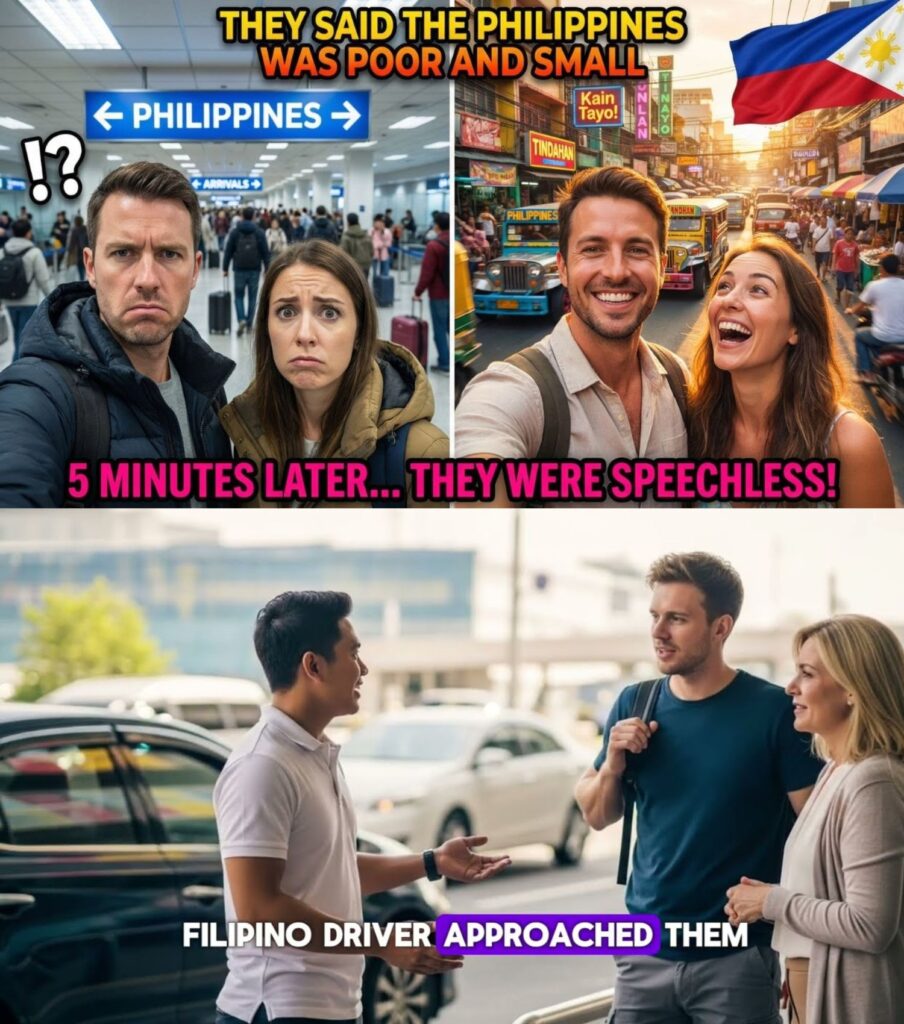
Welcome back to TIT Tales. Today’s story isn’t about a foreigner getting scammed in a bar, or a retiree chasing cheap beer and cheaper trouble. It’s about something quieter, but just as powerful: having your pride cracked open by a country you thought you already understood.
It starts with two people who thought they were worldly. It ends with two people realizing they’d actually been walking around with their eyes half-closed.
My name is Mark Henderson. I’m 42, Canadian, a teacher. My wife’s name is Sarah. We spent 13 years in China, survived pollution, visa runs, and more staff meetings than any human should ever attend. We’d crossed borders, climbed the Great Wall, eaten spicy hotpot at 2 a.m. in Chengdu. We thought we’d seen “Asia.”
We were wrong. And it took the Philippines—this country we’d quietly looked down on—to show us just how wrong.
The story actually starts in a kitchen in Shenzhen.
It was a gray Saturday in February. The air outside our apartment window looked like someone had smeared the sky with a dirty eraser. The kind of day where you feel the pollution in your teeth.
I was at the table doom-scrolling on my laptop, a coffee cooling beside me, when Sarah walked in holding her phone.
“Hey,” she said, dropping into the chair across from me. “You know my contract ends in June, right?”
“Yeah,” I said absently, still half focused on a news article about rising costs in Beijing. “You thinking of renewing?”
She hesitated. That got my attention more than anything she could have said. Sarah is the queen of stability. She renews contracts like clockwork, pays bills early, plans trips six months in advance. Hesitation is not her brand.
“I don’t know if I can do another three years of this,” she said. “The smog, the lockdowns, the… everything. I feel like I’m moving through static.”
I clicked my laptop closed. “Okay,” I said slowly. “So what are you thinking?”
She flipped her phone around. On the screen was a YouTube thumbnail: a couple walking on a white beach under palm trees, “Why We Left China for the Philippines” in big letters.
“The Philippines?” I said, automatically. I heard my own tone and hated it: condescending, skeptical, the way people used to talk about China in 2008.
“What?” she said, frowning. “Why did you say it like that?”
I shrugged, feeling stupid and defensive at the same time. “I mean… isn’t it… dangerous? Poor? Not very developed?” I winced as I said it. The words tasted bad, even as I said them.
Sarah didn’t answer. She just hit play.
On screen, a British couple sat in a bright, airy apartment. They talked about leaving their careers in Shanghai for Manila. They showed clips of cafés, coworking spaces, parks, malls, beaches. They talked about English being widely spoken, about friendly people, about cost of living, about opportunity.
I watched, waiting for the catch. For the shaky camera footage of slums over sad piano music. For the turn.
It didn’t come.
At the end of the video, Sarah muted the phone. “We’ve never even considered it,” she said. “Why?”
“Because…” I started, then realized I didn’t have an actual answer that wasn’t just, “Because of things I’ve heard from other people who also never went.”
News clips of typhoons. Old documentaries focusing on shanty towns. That one story about a kidnapping in Mindanao from twenty years ago. Random comments from other expats who’d never left their WeChat groups.
We’d built a picture of a country entirely out of other people’s selective snapshots.
Sarah looked me straight in the eye. “We always tell our students, ‘Don’t believe stereotypes. Go see the world yourself.’ When was the last time we followed our own advice?”
I hate it when she’s right.
We didn’t decide that day. But a seed had been planted, the kind that doesn’t leave you alone.
Fast forward three months.
Our China leases were ending. Our cupboards were half empty. We’d sold the electric scooter to a colleague. I’d cried a little saying goodbye to my favorite noodle shop.
“Just three weeks,” Sarah said, looking at our tickets. “If we hate it, we can leave earlier. If we like it… we’ll see.”
But our planning sessions had been more like arguments with our own fear.
“What about crime?” I’d say.
She’d pull up statistics showing crime rates compared to other cities we’d visited.
“What about infrastructure?” she’d counter.
I’d shrug and wave vaguely. “I don’t know. I just heard…”
We dug deeper. That’s what we do when students bring us claims in class—we say “Source?” and “What’s your baseline?” So we tried to practice what we preached.
We found articles about BPOs—business process outsourcing—and how the Philippines was becoming a global hub for call centers and remote support. We saw photos of skyscrapers, of modern hospitals, of universities ranked in Asian lists.
And still, we felt uneasy. Because knowledge in your head sometimes loses to stories in your gut.
Our Canadian friends didn’t help.
“You’re moving where?” one messaged on Facebook. “Dude, be careful. I saw a documentary once. Looked pretty rough.”
“You’re going to get kidnapped,” another joked. “Kidding. Sort of.”
Even our colleagues in China had opinions.
“It’s good for holidays,” one said, “but to live? Too unstable.”
All from people who had never set foot there.
We repeated our mantra: Three weeks. If it’s bad, we leave. If it’s good… we stay open.
The day we arrived in Manila, my stomach was tight before we even landed.
From the plane window, the city looked sprawling and chaotic. Patchwork roofs, high-rises, ribbons of traffic. As we descended, I found myself scanning for danger like I wasn’t just on an international flight with crying toddlers and overcooked chicken smell.
We stepped off the plane into the warm, thick air of Ninoy Aquino International Airport.
That’s when the noise hit me first—not aggressive, just… alive. Conversations in Tagalog and English, announcements over the speakers, the hum of dozens of different lives overlapping.
“Stay close,” I murmured to Sarah as we went through the corridor.
She rolled her eyes but moved closer anyway.
Immigration was… normal. A line. Screens. Stamps. The officer smiled at us and said, “Enjoy your stay, sir, ma’am.” Clear English. Professional.
I noted it like a scientist collecting data that didn’t fit my hypothesis.
Baggage claim. Our suitcases arrived. No one tried to snatch them. No one followed us. We walked toward the exit, passing currency exchange counters, a Dunkin’, a Krispy Kreme, a booth advertising SIM cards.
“Looks… like every other airport,” Sarah murmured.
“Don’t relax yet,” I said, the old stories still whispering in my ear.
As we stepped out of the sliding doors into the arrivals area, the heat wrapped around us fully this time. But there was something else wrapped inside it: music, laughter, signs with names, family members craning their necks for returning loved ones.
A young man in a clean polo shirt stepped toward us, holding a small sign that said “Mark & Sarah H.” The hotel had arranged an airport pickup.
He grinned broadly as soon as he saw us. “Hello po! Welcome to Manila!” he said. “I’m Carlo, your driver. First time here?”
That smile disarmed something in me before I could stop it.
“Yeah,” I said, gripping my backpack tighter out of habit. “First time. We’re just visiting.”
“You picked a good day,” he said cheerfully. “Not too much traffic. Maybe only… hmm…” He tilted his head as if calculating. “Fifty percent traffic.”
Sarah laughed. I didn’t. I was still busy scanning.
We followed him out to the parking area. I expected chaos—cars swerving, people shouting, the kind of barely controlled madness we’d seen in some overcrowded parts of southern China.
Instead, we got… normal city airport chaos. Horns, yes. Crowded, sure. But there were lanes. Signs. Guards. Order in the disorder.
We climbed into the van. Sarah took the window seat. I sat aisle, situating my backpack at my feet like a paranoid shield.
Carlo started the engine, merged into the flow, and Manila began to unfold outside the windows.
What happened in the next five minutes cracked our world open.
Here’s what we expected:
Rusty, broken jeepneys spilling black smoke.
Barefoot children banging on windows.
Ramshackle shacks as far as the eye could see.
We’d never said those images out loud, but they’d been living in the back of our minds, fed by documentaries that only filmed the worst neighborhoods, by headlines that framed complexity as “Third World chaos.”
Here’s what we saw instead.
The first jeepney we passed looked like a painting you could drive. Chrome shining, body painted electric blue with streaks of neon pink and green, “GOD’S GRACE” in huge letters across the front. Hand-painted portraits of superheroes and saints on the sides.
“That’s… actually beautiful,” Sarah whispered.
Carlo saw our faces in the rearview mirror and chuckled. “Jeepney po,” he said. “Our local buses. Art on wheels.”
We passed another. This one had “FAMILY FIRST” on its windshield and an elaborate mural of a family holding hands under a bright sky. Not one of them looked “broken down.” They looked like moving canvases.
Behind them, rising out of the city like glass islands, were skyscrapers. Not one or two—dozens. Offices, hotels, condos, glass facades catching the late afternoon sun.
On our right, the view opened up to the bay. On our left, a massive building appeared, its sign glowing: SM MALL OF ASIA.
Sarah leaned forward, eyes wide. “Is that… a mall?”
Carlo laughed. “Yes, ma’am. One of the biggest in the world. You like shopping?”
“We lived in Shanghai for three years,” she said faintly. “That’s… bigger than our mall.”
“Don’t worry,” he said. “We have more.”
I realized my mouth was slightly open. I closed it.
We continued driving. Traffic slowed, giving us time to actually look.
We saw clean sidewalks where people waited at marked crossings. People in office clothes heading home—women in blouses and slacks, men in dress shirts and ID lanyards. We saw cafés with big windows and names we recognized from other cities: Starbucks, Coffee Bean, Tim Hortons—Canadian representation, somehow both comforting and embarrassing.
“What do you do here?” I asked Carlo, needing to anchor what I was seeing in something concrete.
“I work for a hotel, sir,” he said. “And also I study. I attend night classes. Business management. I want to manage my own transport company someday.”
Something in my chest shifted. Driver, student, future entrepreneur—all in one. Not a nameless, faceless “Third World” background extra.
Carlo caught our silence.
“Let me guess,” he said with a tilted smile. “You thought we all live in bamboo huts in the mountains?”
Heat rushed to my face. “We just… heard…” I started, already sounding lame.
He raised a hand, kind. “It’s okay, sir. We know what people hear. They search ‘Philippines’ and they see typhoons and poor areas, crime news. Poverty exists here. Yes. Not going to lie. But it’s not the whole story.”
As we crossed into another district, he gestured with his chin toward the window. “See that?”
We turned. Another skyline. Sleek towers, wide roads, greenery along the sidewalks. A giant sign read: BONIFACIO GLOBAL CITY.
“This is BGC,” Carlo said proudly. “Bonifacio Global City. Many call center offices, startups, embassies. We call it ‘The Manila of the future,’ but actually, it’s the Manila of now.”
Sarah pressed her face to the glass like a kid.
People jogged along clean paths. Kids rode scooters. A cluster of young Filipinos took selfies in front of a modern art installation, their smartphones the latest models, angles practiced, laughter loud and unselfconscious.
“This looks like… Singapore,” Sarah murmured.
Carlo grinned. “And this is only one part. We have Makati CBD, Ortigas, Eastwood…”
I pulled out my own phone, half to distract myself, half to test something. I typed “Philippines literacy rate” into Google.
“Sarah,” I said, brow furrowing. “Did you know the literacy rate here is 96 percent?”
She blinked. “Higher than some Western countries.”
I scrolled. “And they’ve been called the social media capital of the world. Most active internet users globally.”
Carlo laughed softly. “Yes, sir. We love Facebook. And TikTok.”
We continued driving. Past construction sites with cranes. Past clinics advertising “world-class medical care.” Past schools with signs in English and Filipino.
The street vendors I’d been bracing myself for were there—but they weren’t begging. They were grilling skewers, selling halo-halo in plastic cups, hawking phone cases and sunglasses. Business, not desperation.
Kids we passed weren’t in rags. Most wore uniforms—white blouses, navy skirts, neat polos and slacks—walking in small groups, laughing, backpacks bouncing.
“I feel like an idiot,” Sarah whispered.
“You are not idiot, ma’am,” Carlo said gently, eyes still on the road. “You just saw one side before. Many people do.”
We fell silent. Outside, Manila moved. Not as a tragedy, not as a paradise—just as a city alive with millions of overlapping stories.
Our hotel was in Makati, in an area packed with restaurants and bars. From our room window on the 18th floor, the city spread out in all directions. To the west, hints of the bay and the setting sun turning the hazy sky orange and pink. To the east, more towers, more roads, more lights flicking on.
Sarah stood at the glass, arms crossed, watching.
“This… is not what I expected,” she said quietly.
“Me neither,” I admitted.
“What did we expect?” she asked.
I didn’t answer. Not because I didn’t know, but because I finally didn’t like saying it out loud.
We unpacked. Ordered dinner by Grab app—like in China, but easier, because everything was in English and we could actually read the restaurant descriptions without translations. A few taps and we had crispy pata, chicken adobo, garlic rice, and mango shakes on the way.
“Welcome to the Philippines,” the delivery driver said at our door, grinning like Carlo had. “Enjoy your food, sir, ma’am.”
We ate by the window, watching the city blink fully into night.
At 10 p.m., I checked our flight reminder for three days later.
“We could still cut it to just a week,” I said out of habit.
Sarah picked up the remote and turned off the TV. “Let’s give it time,” she said. “We’ve been here ten hours. We owe this place more than that.”
The next morning, something small but important happened.
We took an elevator down, planning to find a café. Inside the elevator, a young woman in a blazer and pencil skirt smiled at us. Her ID badge had a logo I recognized from a multinational tech company.
“Good morning,” she said.
“Morning,” we replied.
“You’re new here?” she asked, not shy at all.
“We arrived yesterday,” Sarah said. “We’re from Canada. Well, we’ve been in China for a long time.”
“Welcome to Manila,” she said. “I’m Bea.” She extended her hand. “I work in BGC, in tech support. Where are you going today?”
“We have no idea,” I said honestly. “We just planned… ‘Manila’.”
She laughed. “Typical foreigner plan. You should visit Intramuros. Old city. Also try local coffee. We have good specialty cafés, not just Starbucks.”
We got off on the ground floor together. Bea checked her watch. “I have a few minutes before my Grab arrives,” she said. “Let me show you a spot.”
She led us around the corner to a narrow side street where a small café was tucked between a laundromat and a pharmacy. Inside: industrial chic. Exposed brick, hanging plants, a blackboard menu listing single-origin beans from Benguet and Kalinga.
“I’ll DM you some suggestions on Instagram,” Bea said after we exchanged handles. “Most people only see traffic and malls. There’s more.”
After she left, Sarah stared at me over her latte.
“She’s 24,” Sarah said. “Works for a global tech company. Speaks perfect English. Gave us better travel advice in five minutes than most travel blogs.”
“Yeah,” I said, looking at the handwritten list of local beans on the wall. “Not exactly the ‘uneducated, poor, weak English’ stereotype, huh?”
We ordered coffee and pandesal sandwiches. The barista asked how we wanted our coffee brewed, explained tasting notes, recommended beans like a sommelier.
“How long have you been doing this?” Sarah asked him.
“Four years, ma’am,” he said. “I learned from YouTube and trainings. I want to open my own roastery someday.”
Two people in 24 hours with concrete plans, global awareness, and better English than some colleagues we’d had in China.
The stereotype crumbled a little more.
Intramuros was our first touristy stop.
The old walled city baked in the late morning heat. Cobblestone streets, horse-drawn kalesas, Spanish-era churches, stone walls that had seen colonizers and revolutions.
We joined a walking tour led by a guy named TJ. He wore a barong and a headset mic, his English theater-level, his knowledge of Philippine history deep and nuanced.
“Most of you,” he said to our group of 15—Americans, Koreans, Australians, us—“have only seen the Philippines in three ways: typhoon footage, boxers, or box office. You know Pacquiao, you know some Miss Universe queens, maybe you know a singer or two. But this country is more than tragedies and pageants. We are more than your maids, your nurses, your call centers.”
As he led us through Fort Santiago, he talked about Jose Rizal, the national hero, executed by Spaniards. He talked about World War II, about Manila being the second most destroyed Allied city after Warsaw. He talked about the years after, the rebuilding, the dictatorships, the people power revolutions, the overseas workers.
“You all probably know a Filipino,” he said. “Somewhere in your life. Maybe you just don’t realize it. The nurse who took care of your grandmother. The coworker in the Zoom call center. The engineer behind the software you use.”
He smiled. “We are everywhere. And we are more educated than you think. Our literacy rate? Ninety-six percent. English? Official language. We do TikTok, yes. But we also write code, run operating rooms, manage ships.”
After the tour, we stayed behind to talk to him.
“You said something about being more than your maids and nurses,” Sarah said. “But isn’t that still… hard? Being known mainly for working abroad?”
He shrugged, but there was tiredness behind the grin. “It’s complicated. OFWs send billions home. They keep this economy afloat. We’re proud of them. But yes, it can be tiring to be seen as service staff only. That’s why it’s nice to see people like you actually coming here to see us in our own country, not just in yours.”
That hit harder than I expected.
“How many Canadians have you met on your tours?” I asked.
“Not many,” he said. “But I’ve taken care of many Canadian patients in the UK, as a nurse, in my previous life.”
“You were a nurse?” Sarah said, surprised.
“Yes,” he said with a shrug. “Then I came home. I wanted to tell our story, not just take care of someone else’s.”
Walking back to the entrance of Intramuros, we passed a group of grade schoolers in uniforms, on a field trip. Their teacher spoke in Taglish: “Okay, class, sino ang nakakaalala what happened here during World War Two?”
Several hands shot up. One kid answered, blending English and Filipino effortlessly as he explained historical events. The teacher nodded and added context in English for some foreign tourists nearby who stopped to listen.
Not poor. Not stupid. Not backward.
Just… normal. Educated. Bilingual. A little loud. A lot alive.
Our days fell into a rhythm.
Morning walks around BGC or Makati, watching the city wake up. Midday escapes into malls when the heat got too intense—these malls weren’t just shopping centers. They were micro-cities: supermarkets, clinics, coworking spaces, churches, rooftop gardens.
We found a coworking space in Ortigas where dozens of Filipino freelancers typed away for foreign clients—video editors, programmers, virtual assistants, content writers. At a table near us, a group of young women switched effortlessly between discussing K-dramas in Tagalog and debating SEO strategies in English.
“You work online?” one asked us when she saw our laptops.
“Not yet,” Sarah said. “Maybe soon. We’re teachers.”
“You can teach online from here,” the woman said. “Lots of platforms. And good internet in this building. Better than some parts of Canada, from what my client says.” She laughed.
We went to Greenbelt in Makati and watched families having brunch at restaurants more expensive than the ones we’d treat ourselves to back in Toronto. We went to UP Diliman and saw students protesting tuition hikes and climate issues, holding signs in Filipino and English, megaphones loud, their arguments sharper than some of our university classmates’ had ever been.
We visited St. Luke’s and Makati Medical Center—hospitals that looked like they’d been dropped straight out of any “first world” city, modern equipment, professional staff, slick admissions processes.
We booked a weekend in Tagaytay and froze our asses off in 22-degree “cold” while eating bulalo overlooking Taal Lake. On the jeepney ride up, we sat next to an older woman in her 60s who chatted with Sarah about her daughter “working in Vancouver as a caregiver.”
We took a domestic flight to Cebu on our second week, then a ferry to Bohol. White sand beaches. Resorts with infinity pools. Yes, out past the tourist zones, we saw poorer communities—houses of wood and tin, kids playing barefoot in dusty lots. But even there, the picture was more complex than our old stereotypes.
A tricycle driver we chatted with in Bohol, named Jun, told us his eldest daughter was studying nursing. “She will go abroad,” he said matter-of-factly. “Maybe UK, maybe Canada. She says she will take me to Niagara Falls one day.” He said it with such quiet certainty that I believed him.
In Manila, we rode a jeepney with students, office workers, a grandmother carrying a basket of vegetables. All scrolling smartphones. All glancing up only to pass fare forward or shout “Para!” at their stop.
One night, walking through a side street on the way back to our hotel, Sarah grabbed my arm.
“What’s wrong?” I asked, heart jumping.
She nodded ahead. Two kids sat on the curb, sharing a single tablet, watching what looked like a cartoon. Their school bags lay beside them; their uniforms were slightly dirty from a full day of play.
“Look,” she whispered. “That could be any kids, anywhere.”
The more we looked, the less “exotic” the place became and the more it felt like a mirror with different lighting.
Of course, not everything was perfect.
We saw homeless families huddled under flyovers. We saw lines for cheap rice. We heard about political scandals, inflation, commuters stuck for hours in traffic or squeezed into old trains.
But here was the difference between what we thought we’d see and what we actually saw:
We thought poverty would be the whole story. Instead, it was one page in a much larger book.
We thought danger would feel constant. Instead, we walked around at night in busy districts and felt… fine. Cautious, yes—like we’d be in any big city—but not hunted.
We thought we’d be surrounded by people desperate to leave. Instead, we met dozens who had worked abroad and chosen to come home, or who were building careers that let them stay with their families.
Back in our hotel one night, I opened our group chat with friends in Canada.
“So how dangerous is it?” one had asked the first week.
I scrolled back, reading my own nervous replies from before we arrived. Then I looked out the window at the skyline, at the people sitting at rooftop bars, at the kids practicing dance moves in a parking lot.
I typed: “It’s a big city. It has problems. But it’s also modern, creative, and way more developed than we thought. Honestly… we were wrong.”
A friend replied with a laughing emoji and a “Told ya!”—even though she’d never been here either. People hate updating their worldviews. It threatens their sense of being “in the know.”
I realized: that’s what I’d been clinging to. The feeling that because we’d lived in Asia for 13 years, we already knew how this region worked.
The Philippines humbled us—in the best way.
The moment that really broke me happened at Manila Bay.
Carlo, our driver from day one, had become something of an unofficial guide. We’d requested him again for airport transfers and a few day trips. He’d begun to speak more openly as he got comfortable.
“Why did you stay in China so long?” he asked us one night as we approached the baywalk area.
“Work,” I said. “Stability. Money.”
“Did you like it?” he asked.
“Yes,” Sarah said. “Mostly. We learned a lot. But toward the end… we were just existing. Not really living.”
Carlo nodded. “Many Filipinos go there for work, too,” he said. “Or to other countries. Middle East, Europe. My cousin is a nurse in England. She says weather is cold but salary warm.” He laughed at his own joke.
We parked near Manila Bay at sunset. Vendors sold street food: fish balls, kwek-kwek, taho. Families walked hand in hand. Groups of teenagers took group selfies with the orange sky as a backdrop. Couples sat on the seawall sharing snacks.
We stood there, the three of us, watching the colors change. The sky went from bright orange to neon pink to deep purple, the water reflecting every shift.
“I feel… terrible,” Sarah said softly.
Carlo glanced at her, puzzled. “Why, ma’am? You don’t like the sunset?”
“No,” she said quickly. “It’s beautiful. It’s just… we judged all of this. All of you. From far away. We thought—we thought we were so educated, so worldly. But we believed the same stereotypes everyone else did.”
I swallowed hard. “We’ve been in Asia for over a decade,” I said. “We thought we understood the ‘developing world.’” I used air quotes and hated myself a little more. “But really… we had a tiny picture in our heads and we let it define millions of people.”
Carlo looked back at the sunset, then at us. There was no anger in his face. Just something like quiet amusement and, weirdly, pride.
“Don’t feel so bad, sir,” he said. “You’re not the first to think that. You won’t be the last. But you’re here now. You’re seeing with your own eyes. That’s what matters.”
He pointed at the stretch of city behind us. “The Philippines isn’t perfect. No country is. We have corruption, traffic, poverty, typhoons. We also have 110 million people who wake up every day and still find a reason to laugh. We have a fast-growing economy, big BPO industry, OFWs, TikTokers, startup founders, farmers, jeepney drivers with college degrees.”
He smiled, a little mischievously. “We’re not small. We’re not as poor as the old stories say. And we are definitely not just your stereotypes.”
We stood there, the waves slapping against the seawall, the city buzzing behind us, the last light fading.
“We almost missed this,” I said quietly.
Sarah nodded. “Because we believed what other people told us instead of coming to see for ourselves.”
Carlo shrugged. “Now you know. And when you go back, you can tell a different story.”
That night, back in the hotel room, we sat on the bed with laptops open.
Our return flight was in two days.
Sarah looked at me. I looked at her.
“Three days,” she said. “That’s all we gave this place in our minds. Three days for an entire country.”
“How long have we been here now?” I asked.
“Seventeen days,” she said. “And we haven’t even left Luzon except for that one trip to Cebu and Bohol.”
We stared at the airline booking page.
“We could… extend,” she said tentatively. “Change the ticket. Two more weeks?”
“We said three weeks max,” I replied.
She raised an eyebrow. “We also said the Philippines would be poor, dangerous, and depressing. How’d that prediction go?”
I laughed, the defensive shell finally cracking completely. “Okay,” I said. “Two more weeks. We’ll go to Iloilo. Davao. Maybe Palawan if we can swing it. We’ll see universities, not just beaches. We’ll talk to more people.”
She clicked. Flights rearranged. Hotel extended.
“Done,” she said. “We’re staying.”
I lay back on the bed, staring at the ceiling.
“The Philippines isn’t small,” I said slowly. “Our perspective was.”
“The Philippines isn’t poor,” Sarah added. “Our understanding was.”
We let the silence finish the rest of the thought: And the biggest shock? We almost missed all of this. Because we trusted stereotypes more than we trusted our own eyes.
Over the next two weeks, we saw more layers.
In Iloilo, we visited a small software company run by a 30-year-old founder who’d studied in Manila and had clients in the U.S. and Europe. His team of developers wrote code in between karaoke sessions at lunch, debugging while singing 80s ballads.
“Most of our clients still imagine we’re working in some shack,” he said, laughing. “Then we turn on our cameras and they see this office. They’re like, ‘Where are you again?’”
In Davao, we walked through clean parks where kids flew kites and teenagers practiced dance routines to K-pop songs. We talked to a woman who ran a small cacao farm and sold chocolate bars on Instagram, shipping them across the country in insulated boxes.
“Our grandparents were farmers,” she said. “We still are, but now we have smartphones.”
One afternoon, on a ferry between islands, we sat next to a family returning from a relative’s graduation.
“My son just finished nursing,” the father told us proudly, in carefully phrased English. “He will take board exam. Maybe go abroad. But he says… maybe not forever. Just for experience. He wants to come home. Build something here.”
“Is he the first in your family to graduate university?” Sarah asked gently, expecting a familiar story arc.
The father shook his head. “No, no. We are many graduates. My daughter is accountant. My wife is teacher. But he is the first nurse.” He smiled. “In Canada, maybe, this is normal. For us, also it is becoming normal.”
Normal. There it was again.
Not miracle. Not tragedy. Just a country moving, unevenly, imperfectly, toward something better.
On our last night in Manila, before flying back to Canada for a visit, we asked Carlo to pick us up one more time.
He arrived at the hotel lobby with his usual wide smile.
“Last night po?” he asked.
“For now,” Sarah said. “We’re coming back.”
“Good,” he said. “This country is like adobo. Better the second day. More flavor.”
He drove us around one last time, through BGC’s gleaming lights, past Makati’s skyscrapers, through quieter neighborhoods where sari-sari stores glowed blue under fluorescent bulbs.
We passed a tricycle driver laughing with his passengers. A security guard helping an old woman cross the street. A group of construction workers sharing a bottle of Coke on a curb, tapping their phones, earbuds in.
At a stoplight, a boy about twelve years old approached, selling sampaguita garlands. My stereotypes braced for a pity scene. Instead, he flashed us a grin, rattled off a sales pitch in rapid Taglish, then switched to English when he heard our accents.
“One garland, sir, ma’am? Support my schooling. I sell after class only. Promise, I’m good boy.” He winked.
Carlo rolled down the window. “Uy, nag-aaral ka pa ba talaga, ha?” he teased.
“Oo naman, kuya,” the boy said, placing a hand over his heart. “Top five pa rin.” He pointed at his school ID proudly hanging around his neck.
We bought two garlands. The boy thanked us, then darted back to the sidewalk, where another kid was showing him something on a phone—probably a game, maybe a TikTok, definitely a slice of the same digital world kids in Toronto live in.
The light turned green. We moved.
“Do you still feel… scared here?” Carlo asked me suddenly.
I thought about it.
“Not scared,” I said. “Sometimes overwhelmed. It’s a lot. But no… not scared.”
He nodded. “That’s good.”
We stopped briefly by Manila Bay again, rolling down the windows to let in the humid night air. The smell of salt, street food, exhaust, and something sweet.
“Thank you,” I said, surprising myself with the sudden lump in my throat.
“For what, sir?” he asked.
“For opening our eyes,” Sarah said before I could fumble. “You didn’t make us feel stupid. You just… showed us.”
Carlo shrugged, a little shy for the first time. “I just drove,” he said. “You opened your eyes yourself.”
He extended his hand backward between the seats. I shook it.
“Welcome to the Philippines,” he said again, but this time, it felt different. “The country you didn’t know existed…”
“…but will never forget,” Sarah finished.
We laughed, the three of us.
Back in Canada a month later, sitting in my parents’ kitchen in Toronto, my dad asked the question I’d been waiting for.
“So,” he said, spooning sugar into his tea. “How was it? That place… the Philippines? Dodged any kidnappings?”
I set my mug down, a slow smile spreading across my face.
“It was… beautiful,” I said. “Messy. Loud. Modern. Complicated. Smart.”
He blinked. “Modern?”
Sarah pulled up photos on her tablet. BGC’s skyline at night. Intramuros at sunset. A coffee shop with latte art and MacBooks. A classroom full of uniformed kids reciting in English. A nurse in scrubs dropping by Iloilo airport, going back to her job in London.
“We were wrong about it,” she said simply. “Completely wrong.”
Dad looked, frowned, shook his head like the images were glitching.
“Huh,” he said. “News doesn’t show that.”
“News shows what makes you click,” I said. “Typhoons, floods, crime. That’s part of the story. But it’s not the whole story.”
We started telling him about Carlo, about Bea, about TJ the ex-nurse tour guide, about Jun the tricycle driver whose daughter was going to see Niagara Falls one day. About our own fears and how reality had dismantled them, gently but firmly.
At some point, Dad leaned back, exhaled.
“Guess I’m not as up-to-date as I thought,” he admitted.
“None of us are,” I said.
So here’s the point, if you’ve made it this far.
This isn’t an ad for Philippine tourism. This isn’t a denial of real issues—poverty, inequality, politics. They’re there. You see them if you look.
But they’re not the only thing there.
In just a few minutes of driving through Manila, everything we thought we knew cracked. In a few weeks, the cracks widened into a complete rebuild of our mental map.
The biggest thing we learned?
The Philippines wasn’t small. Our perspective was.
The Philippines wasn’t poor. Our understanding was.
And the most uncomfortable realization: we almost missed all of it because it was easier to believe lazy stereotypes than to admit we didn’t know.
Maybe you’ll never visit Manila. Maybe you will. But this story isn’t just about one country. It’s about any place you think you’ve already figured out from the outside.
The “dangerous” neighborhood you only drive through with locked doors.
The “backward” state you make jokes about.
The “third world” country you reduce to one sad image in your head.
Here’s the truth: you don’t know a country until you’ve walked its streets, ridden its buses, gotten lost in its malls, sat in its traffic, listened to its jokes, heard its music in cheap speakers at sunset. You don’t know its people until you’ve looked them in the eye and realized they have plans as specific and complex as yours.
Mark and Sarah—we—thought 13 years in China made us wise. The Philippines showed us we were still students. And honestly? I hope we never stop being students again.
If you take anything from this story, let it be this:
Never judge a country by its headlines, its worst neighborhoods, or the loudest stereotypes. Judge it—no, meet it—by experiencing it yourself, by listening more than you talk, by letting it surprise you.
Because sometimes, all it takes is five minutes driving through a city you’ve been taught to fear… to realize the only truly dangerous thing was how narrow your mind had become.
And if you’re Filipino, reading this from Manila or Dubai or Vancouver—you were right all along. Your country was never just what the world said it was. We’re just catching up.
Thanks for listening, TIT Tales family. Stay curious out there. And if you ever find yourself about to repeat a stereotype about a place you’ve never been… maybe book a ticket instead.
News

Pinagtawanan ng China ang mga Pilipinong sundalo🇵🇭 – Ang sumunod na nangyari ay pinatahimik sila
“Tinukso ng Tsina ang mga Sundalong Pilipino🇵🇭 – Ngunit Ang Nangyari Sunod ay Nagsalita sa Kanilang Katahimikan!” There are moments…
Ang kantang Pilipino na nagpaluha sa isang sundalong Ruso at nagbuklod ng dalawang bansa sa pamamagitan ng musika
“Ang Awit ng Pilipino na Pumatak ng Luha sa Isang Sundalong Ruso at Nagbuklod sa Dalawang Bansa sa Pamamagitan ng…

Isang Nag-iisang Tatay ang Nag-alay ng Buong Pamilya Namin na Ipon para sa Isang 24-Taong Gulang sa Thailand
“Ang Aming Nag-iisang Tatay Ay Nagbigay ng Lahat ng Ipon ng Pamilya Para sa Isang 24 Taong Gulang sa Thailand!”…

Akala niya ako ay isa lamang ibang dayuhang Western. Mali siya. 🇹🇭
“Inisip Niya Na Ako Chaka Lang Na Kanlurang Dayuhan, Ngunit May Ibang Kwento Akong Ikwento!” 🇹🇭 Welcome back sa TIT…

82.4% ng mga Western Retirees ay Naiiwanang Walang Pera sa Thailand – Narito ang Katotohanan 🇹🇭
HINDI KA ESPESYAL: ANG LIHIM NA KAPARUSAHAN NG 82.4% Welcome back sa Tit Tales—pero sa version na ’to, hindi ka…

Payo ni Robin na ‘never surrender’ kay Bato, pinatutsadahan ng Palasyo
PAK! ANG PAYONG “NEVER SURRENDER” NI ROBIN PADILLA KAY BATO NA PINATUTSADAHAN NG PALASYO — ANG BUONG KWENTO SA LIKOD…
End of content
No more pages to load