Paano Napadpad ang Mga Estudyante mula sa Peru sa Pilipinas? Ang Kakaibang Kwento na Magpapa-bighani sa Iyo!
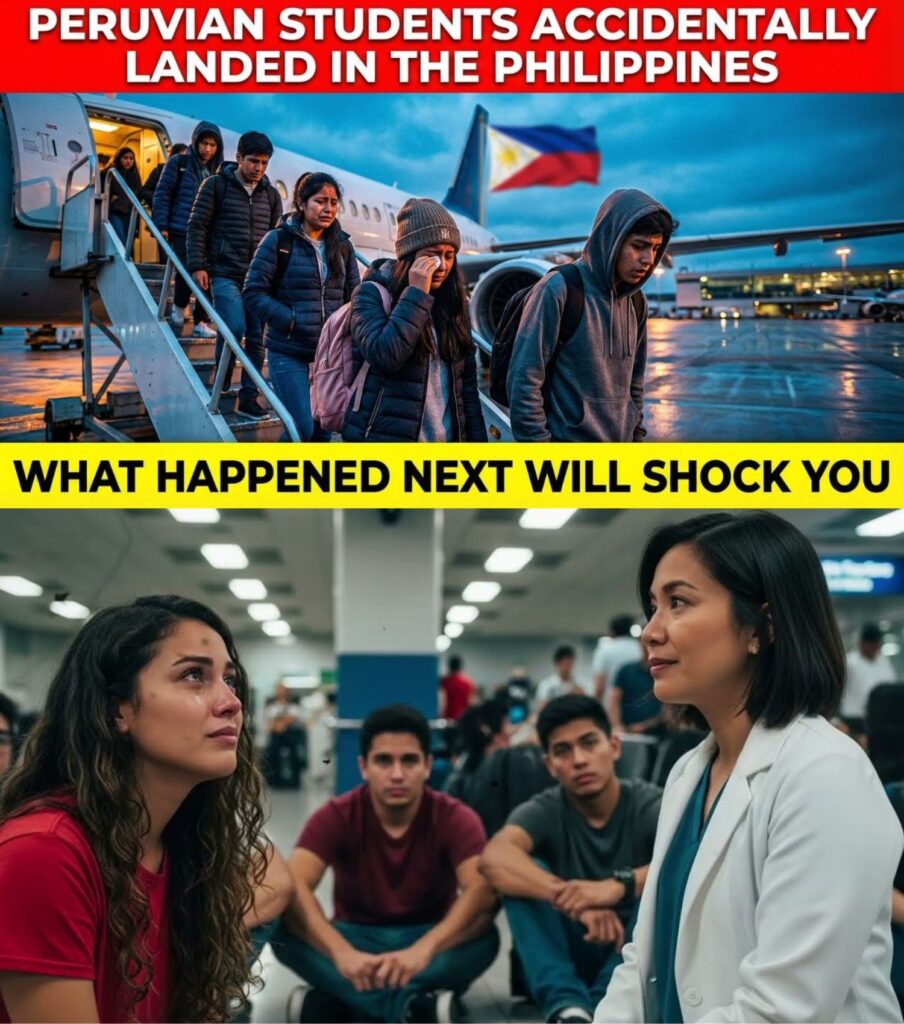
Maria Gonzalez had always thought the most terrifying thing in science was failure—experiments that refused to produce results, trial runs gone wrong, months of data invalidated by a tiny miscalculation. She had prepared herself for all of that. What she had never prepared for was the possibility that the universe itself might take three years of work and knock it out of the sky somewhere between Lima and Singapore.
She checked her boarding pass for the fifth time, though she already knew every printed detail by heart.
Flight: SA 447. Route: Lima → Singapore (via a brief refuel in São Paulo). Seat: 34A. Boarding time: 21:10. Purpose: everything.
Around her, the departure gate was a blur of blue and white conference jackets—the official uniform their university had given them. On the back of each was printed: Peru Youth Marine Science Delegation – IYMSC Singapore 2027. The jackets were a little too warm for the humid Lima night, but none of them took theirs off. The jackets weren’t there to keep them warm. They were there to remind them that this—this flight, this trip, this conference—was the culmination of three years of late nights, broken equipment, grant rejections, and stubborn hope.
“Eighteen hours until we present,” Diego whispered, appearing at Maria’s side, his voice vibrating with a mixture of nerves and adrenaline. He squeezed her hand once, quick and firm, like he was grounding himself as much as her. “We’re going to kill this, María. Te lo juro.”
She smiled despite the knot in her stomach. Diego’s curls were as wild as ever, his conference jacket unzipped, his lanyard crooked. He didn’t look like someone on the verge of a career-defining presentation. But she knew how his voice changed when he talked about their coral plots, how his eyes lit up when he pointed at graphs of regeneration curves.
“I hope so,” she murmured. “We didn’t spend three years smelling like seawater and algae for nothing.”
Behind them, Ricardo clutched a worn notebook filled with sketches of coral structures, flipping the pages compulsively. Camila was triple-checking the USB drives that held their slideshow and backup data. Twenty more students milled around the gate, all part of the Peruvian delegation, all carrying some version of the same dream: to prove that their research mattered, that their country mattered in a field dominated by bigger economies.
A boarding announcement crackled over the speaker, and they moved as one, a tide of blue jackets and rolling suitcases. As Maria stepped into the jet bridge, the familiar smell of airplane air—recycled, thin, tinged with coffee and disinfectant—wrapped around her. She exhaled slowly.
“This is it,” she whispered.
“You mean, this is the beginning,” Diego corrected her, grinning. “The real ‘it’ is when you’re on a stage in Singapore and people are tweeting about your talk in real time.”
She rolled her eyes, but she held on to his words like a talisman.
The first leg of the flight was uneventful. Maria watched the lights of Lima fall away, tiny constellations scattered over a dark coastline. She listened to the dull roar of the engines and the murmur of passengers settling in. Somewhere over the endless black of the Pacific, she fell asleep with her head against the window, dreaming of brightly lit conference halls, of microphones and applause, of professors whose names she’d only seen on papers coming up to shake her hand.
In her dream, she stood on a stage in Singapore, the massive conference logo glowing behind her and the words Mollusk-Assisted Coral Regeneration in Post-Bleaching Ecosystems: A Peruvian Case Study written in bold on the screen. She could feel the weight of every eye in the room as she clicked to the next slide, showing the before-and-after footage of their test plots.
She heard the applause before she even finished her conclusion.
She woke up to a very different sound.
“Ladies and gentlemen,” came the pilot’s voice over the intercom, too calm in a way that made Maria’s heart spike, “we are beginning our descent into Manila.”
For a second, she thought she was still dreaming. Manila? She blinked, sat up straighter, checked the screen on the seatback in front of her. The little plane icon, which should have been inching toward Southeast Asia in a smooth arc, was instead angling down toward a cluster of islands she hadn’t bothered to memorize on the map.
Manila. Philippines.
Someone at the back gasped. A few rows ahead, a baby started crying. Maria’s chest tightened.
“Due to a critical navigation system malfunction,” the pilot continued, “we are unable to proceed to Singapore at this time and will be making an emergency landing at Ninoy Aquino International Airport in the Philippines. We apologize for the inconvenience.”
“Inconvenience?” Miguel’s voice cracked somewhere to their left. “¡Estás bromeando! We have a presentation in—” He fumbled for his watch, realized he had no idea what local time it was. “—in less than a day.”
Maria checked her own watch, then tried to calculate across three time zones. Her brain refused. Numbers splintered in her mind, replaced by one clear thought: This can’t be happening.
“Calm down,” Diego said, though his own hands were trembling as he grabbed his phone. “We’ll land, they’ll fix it, we’ll… we’ll catch another flight. We have time. We still have time.”
But Maria’s stomach had already dropped lower than the plane.
By the time they finished their descent, the cabin was a mess of whispered prayers and frantic texting. The lights of Manila spread beneath them in chaotic clusters, the city coastline curling like a question mark around the dark bay. The landing gear thudded, the runway lights rushed up, and then, with a jolt, they were on the ground.
It wasn’t until she was on the airplane stairs, Manila’s thick, wet heat slamming into her like a wall, that she realized her knees were shaking. The sky was a washed-out gray, heavy with humidity, the tarmac shimmering. She clutched the handrail so hard her knuckles went white.
Around her, the other Peruvian students were unraveling. One girl clung to her carry-on like it was a life raft. Another was on the verge of hyperventilating. Ricardo, who had faced storms at sea with stoic calm, suddenly sank to his knees on the stairs, hands over his face, sobs tearing out of him.
“This can’t be happening,” he choked. “This can’t be happening.”
Camila’s mascara streaked down her cheeks as she stared at the terminal in disbelief, hands pressed to her mouth. “We’re supposed to be in Singapore,” she whispered. “We’re supposed to be there. We worked so hard…”
Diego was pale as he stared at his phone screen. His thumb dragged over the map application, chewing on his lower lip. “Manila to Singapore,” he muttered. “Two hours thirty-five minutes. Maybe three, with boarding. Our presentation is in—” He checked the world clock, swore under his breath. “Nine hours.”
Nine hours. Nine hours between now and the moment Maria was supposed to stand on a stage an entire country away.
Nine hours, and they were stuck on a runway in a country they weren’t even supposed to set foot in.
Her phone buzzed in her hand. She glanced down and saw the name flash on the screen: Dr. Reyes – IYMSC Coordinator.
Maria, please confirm your arrival in Singapore. Your presentation is in 9 hours.
Her fingers slipped. The phone slid from her grip, hit the tarmac, and shattered, spiderweb cracks blooming across the screen like a cruel mirror of the bleached coral in their control plots.
Three years of work, one emergency landing, one broken phone.
Maria felt something in her chest tear.
The airport smelled of jet fuel and sweat and something fried. The lines in immigration were longer than she’d ever seen, snaking across the hall in chaotic zigzags. Signs in English and Filipino hung overhead, but the words blurred together in her field of vision.
“Next!” barked the immigration officer, looking tired, a fan whirring ineffectively beside his glass window. Maria stepped forward, sliding their group passports under the panel with hands that felt like they belonged to someone else.
“Purpose of visit?” the officer asked without looking up.
“Transit,” Maria said quickly. “We’re on our way to Singapore. Our plane had a malfunction. We have a conference, our presentation is—”
The officer finally looked up, eyes sharp. “Do you have Philippine visas?”
“Visas?” She blinked. “No. We were just flying through—”
“Then you need emergency entry permits. That office over there,” he said, pointing to a booth labeled Special Permits & Emergency Visas with a hand that had clearly done this a hundred times. “Wait time is four to six hours.”
“Four to six—” Maria’s voice rose. “We don’t have six hours! We—”
But he had already slid their passports back across the counter and shouted, “Next!” The line moved, swallowing the chance to argue.
The emergency office was a sauna. The air conditioning unit rattled uselessly in the corner, failing to fight the combined body heat of at least fifty desperate travelers. Kids cried. A businessman in a suit shouted at a clerk. A woman in a sari fanned herself with a stack of forms.
They were handed papers printed in English and Filipino, dense blocks of legal language that might as well have been written in code. Maria’s Spanish-English bilingual brain struggled to parse the phrases “temporary authorized stay” and “subject to approval” while a clock on the wall ticked in mocking slow motion.
Miguel slammed his pen down on the plastic table, the sound sharp enough to make Maria flinch. “Even if they let us in,” he said, voice rough with anger, “even if we find a flight to Singapore, we’ll never make it in time. It’s over.”
Nobody argued.
The room swam a little. Maria checked the battered remains of her phone again; the cracked screen still worked if she tapped carefully. A new message from Dr. Reyes:
Your presentation slot has been given to the Argentina team. I’m extremely disappointed. The committee expected more from you.
Her vision tunneled. Around her, the voices of her teammates blurred together into a fog of panic and despair. Camila had her face buried in her hands, shoulders shaking. Ricardo stared at the wall, eyes glassy. Diego’s fingers flew over his phone screen, searching for flights that didn’t exist, refreshing airline apps as if he could will a solution into being.
“Maybe we should just go home,” someone whispered behind her.
Maria stood up so fast her chair scraped loudly against the floor. “I—bathroom,” she managed, not sure who she was speaking to, and walked away on legs that felt like rubber.
The airport bathroom was aggressively fluorescent and smelled vaguely of bleach and cheap perfume. She locked herself into a stall, sat on the closed toilet lid, and folded forward until her forehead touched her knees.
Then she broke.
The sobs came hard and ugly, the kind she hadn’t let herself cry since she was a kid. Tears, snot, shuddering breaths that turned into wordless sounds. She covered her mouth with her hand to muffle the noise, but it still echoed in the tiled space.
Three years. Three years of waking up at 4 a.m. to beat the tide, of hauling equipment across slippery rocks, of diving in cold water until her joints ached, of running statistical analyses until her eyes blurred from staring at the screen. Three years of believing that if she just worked hard enough, if she just proved enough, the world would have to take her seriously.
And now? A random electrical failure in a navigation system had uprooted all of it. A handful of numbers on a broken screen, a new dot on the map. Manila, not Singapore. Missed slot. Lost grant. Disappointed advisor. The Argentina team—who had been friendly, but definitely competitive—standing on a stage that should have been theirs.
She had imagined many scenarios in which their research failed. She had never imagined a scenario where they never even got the chance to present it.
“We worked so hard,” she choked out into the empty stall. “Why did this happen to us? What did we do wrong?”
The tiles, uncaring, did not answer.
Two hours later, emerging with swollen eyes and washed face, she found the group sprawled near a set of plastic chairs in a quieter corner of the terminal. Their emergencies visas had been approved at last, but it felt like a cruel afterthought. They were permitted to enter a country they did not plan to be in.
Enter… and do what? Sit in a budget hotel? Wait for a rescheduled flight back to Lima? Tell their university, their families, their own younger selves, We tried, but fate had other plans?
“Excuse me,” a voice said in lightly accented English. “Are you the Peruvian students from flight SA 447?”
Maria looked up, expecting another official with another problem. Instead, she saw a woman crouching down to their level, around forty, wearing jeans and a University of the Philippines t-shirt, her dark hair pulled back in a practical ponytail. Her eyes were tired but bright, like someone used to long hours and longer problems.
“Who’s asking?” Maria replied, more sharply than she meant to.
“I’m Dr. L. Santos,” the woman said. “Marine biologist. I teach at the University of the Philippines, Diliman. I… saw the news about your flight.” She gestured vaguely toward the ceiling, where TV screens showed an endless loop of headlines and footage.
News. Of course. An international flight forced to land unexpectedly. Cameras, reporters, sensational captions. Maria’s stomach twisted. She imagined her exhausted face plastered on some segment about “stranded students.” Failure made public.
“I also saw your names,” Dr. Santos continued. “The list of delegates for the International Youth Marine Science Conference. That’s how I knew who you were. You’re Maria Gonzalez, right?”
Maria blinked. “How do you know my name?”
Dr. Santos smiled faintly. “Your paper on mollusk-assisted coral regeneration in post-bleaching environments. I’ve cited your work twice. I’m actually teaching it in my graduate seminar next semester.” She dug into her worn canvas bag and pulled out a laptop, balancing it on her knees. A few taps, and the screen filled with images of ghostly white coral—bleached reefs that looked more like graveyards than ecosystems.
“This is the Sulu Sea,” she said quietly. “One of our richest marine areas. We’re experiencing massive coral bleaching. We’ve tried conventional restoration techniques. They’re too slow. We’re losing entire sections before they can recover.” She turned the laptop so Maria, Diego, and the others could see. “You’ve developed a method in Peru that speeds up regeneration using mollusk symbiosis. Correct?”
Maria felt her brain stutter. “Yes, but… we’re still in trials. It’s not perfect. And our conference—”
“What I’m saying,” Dr. Santos cut in gently, looking around at each of them, “is that we need your help. Not in a conference hall. In the water. In the reefs. Right now.”
Diego frowned, disbelief warring with curiosity. “What are you saying exactly, doctora?”
“Stay in the Philippines,” she said, as if it were that simple. “Not as tourists stuck between flights, as visiting researchers. I can file for a special permit and institutional sponsorship. Two weeks at our field station in Batangas or Palawan. Real fieldwork. Real data. Your method, tested on Philippine coral reefs.” She hesitated, then added, “I can’t give you back your conference slot. I can’t make Professor Reyes less angry. But I can give you something better than a twenty-minute presentation.”
“Better?” Miguel said bitterly. “We just lost a $50,000 grant. Our future advisors were in that room. Our—”
“Science,” Dr. Santos cut in again, more firmly this time, “is not about conferences. It’s about the work.” Her gaze softened. “Fifteen years ago, I was supposed to present at a major conference in Tokyo. A typhoon hit, grounded all flights out of Manila. I thought my career was over. A Brazilian professor I’d admired from afar found out, invited me to work with his team instead, remotely at first, then on joint field projects. He told me something I’ve never forgotten.” She took a breath, her voice dropping into a careful mimicry: “‘Conferences are just mirrors, Elena. They reflect what you’ve done. They don’t create it.’”
She closed the laptop with a quiet click and stood.
“So I’m asking you now,” she said. “Do you want to do the work? Not the performance. The real, messy, exhausting, beautiful work?”
Maria looked around at her team. Their faces were drawn, skin sallow from airport lighting and stress, eyes swollen from crying. But beneath the exhaustion, there was something else: the same stubborn flame that had carried them through storms and setbacks.
Her chest ached. “What would we need to do?” she asked, her voice small but steady.
“Sign some forms,” Dr. Santos said, with a hint of a smile. “Call your university. Convince them this isn’t you running away from a failure, but stepping into an opportunity. Then pack light. You won’t need business clothes where we’re going. Just rash guards, notebooks, and a willingness to get very, very tired.”
Day three at the research station in Anilao, Batangas, the water smelled like possibility and damp neoprene.
The station was perched on a rocky shoreline, painted in fading blues, with solar panels glinting on the roof and wetsuits hanging like strange flags from a line. It wasn’t glamorous—no sleek conference halls, no polished microphones—but to Maria, it felt more like the heart of marine science than any auditorium had ever seemed.
She woke each morning to the sound of waves slapping against the hulls of small boats and the distant laughter of fishermen prepping nets. The air was thick with salt, sunscreen, and instant coffee. Sleep had become a suggestion rather than a guarantee; they were up before dawn, loading tanks, checking equipment, reviewing dive plans.
On paper, it should have been everything she had ever wanted: full days in the water, testing a technique she had helped design, working side by side with local researchers whose knowledge of these reefs went deeper than any satellite image could show.
But every night, lying on her bunk in a small dorm room shared with three other girls, Maria stared at the ceiling and thought about Singapore.
She imagined the Argentina team walking onto the stage with relaxed smiles. She imagined the screen behind them displaying slides that could have been theirs—detailed photos of experimental plots, graphs of regeneration speeds, labeled diagrams of mollusk-coral interactions. She imagined the judges nodding, the room murmuring, the polite questions afterward.
She imagined the email they had actually received: The Argentina team has been awarded second place and a $50,000 grant.
I’m extremely disappointed.
You had such promise.
Such promise. The phrase wrapped around her chest like kelp, tugging her down, tangling her.
On the third night, sleep refused to come. She turned over once, twice, listened to Camila’s soft breathing, to the rustle of fabric as someone shifted in the bunk above. Finally, she swung her legs over the side of the bed, slipped into her sandals, grabbed a hoodie, and stepped out into the night.
The station was quiet. Most of the lights were off, leaving only a faint glow from the lab building. The sky was clear, unfamiliar constellations scattered across it. The sea, just a few meters away, was a dark, breathing presence.
She walked down to the narrow strip of sand and sat, drawing her knees up to her chest. The water was impossibly calm, as if nothing in the world could disturb it. Waves whispered secrets to the shore.
“We worked so hard,” she whispered to the ocean, and her voice broke on the words. “We did everything right. We followed every guideline, triple-checked every dataset. Why did this happen to us? Why like that? Why now?”
The ocean offered no answers, only the same steady cadence: in, out, in, out.
“Can’t sleep either?” a voice asked softly.
Maria startled, turning to see Dr. Santos approaching, hands in the pockets of a worn hoodie, flip-flops making soft slapping sounds in the sand.
“Sorry,” Maria said quickly, wiping at her eyes. “I didn’t mean to—”
“You didn’t do anything wrong,” Dr. Santos said, lowering herself onto the sand beside her. “Insomnia is practically a rite of passage in research.”
Maria let out a messy laugh that was half-sob. “I feel like I failed everyone,” she confessed. The words poured out now that they’d been cracked open. “My team trusted me. I helped plan the grant proposal, I pushed us to submit to Singapore. I told them, This is our moment. And then—”
“You didn’t crash the plane, Maria,” Dr. Santos interrupted gently. “You didn’t program the navigation system. You didn’t decide where the storm cells formed or where the electrical glitch would happen. You didn’t choose this.”
“I should have had a backup plan,” Maria insisted helplessly. “Another flight, another route—something.”
“Maybe,” Dr. Santos said. “Or maybe you did everything you could with the information you had.” She looked up at the sky, picking out a scattering of stars. “What you did choose was to keep going after everything went wrong. That’s what matters now.”
Maria dug her fingers into the sand, feeling its cool, gritty texture. “What if—” She swallowed. “What if our research here doesn’t work? What if we run all these trials, exhaust ourselves, and nothing happens? What if we wasted the conference, and the time, and the money, for nothing?”
Dr. Santos was quiet for a moment. When she spoke, her voice was thoughtful, not dismissive. “Then at least you tried,” she said. “And that’s something the Argentina team can never say. They gave a very good presentation, I’m sure. They showed pretty graphs and answered intelligent questions. But they went home after that. You’re still here. You’re not just talking about data. You’re creating it.”
Maria wanted to let that sink in, to let it wash away the guilt and fear. But doubt was stubborn. It clung like algae to her thoughts, refusing to be scrubbed clean in a single conversation.
She didn’t answer. Dr. Santos didn’t push.
They sat in silence for a while, listening to the waves. A distant dog barked. Somewhere up the hill, a tricycle engine coughed to life and then died. The world, indifferent to conferences and grants and broken planes, went on.
“Try to sleep a little,” Dr. Santos said eventually, rising to her feet and brushing sand from her hands. “Tomorrow’s a big day. Good work needs rest, too.”
Maria nodded, though she didn’t move until the older woman’s footsteps had faded. When she finally returned to the dorm, the sky at the horizon was just starting to pale.
Sleep came in fits and starts. When her alarm went off at 5 a.m., she felt like she’d only blinked.
They almost missed it.
Day twelve dawned like any other at the station—humid, salty, full of checklists. They had been running their trials in multiple reef plots for over a week now, carefully placing mollusks, monitoring coral health, logging growth rates. So far, the results looked… promising. Slightly better than the control groups, but not dramatically.
“Incremental,” Diego had said with a shrug. “Better than nothing, but nothing to make Nature pick up the phone.”
The morning dives were uneventful. The water was clear, visibility good. Maria moved through the familiar routine: checking her tank, running her fingers along the careful arrangement of test colonies, taking photographs, scraping small samples, logging observations on her underwater slate.
Back at the lab, the air conditioning hummed as they transferred samples, ran enzyme tests, stared at computer screens. The smell of ethanol and sea salt hung heavy.
At some point in the afternoon, a storm rolled through. Rain drummed on the roof, turning the world outside the small lab windows into a gray watercolor. Lightning flashed, a low rumble of thunder following.
Maria lost track of time among the numbers. She was halfway through recalculating a series of regeneration rates when the lab door burst open with a bang, slamming against the wall hard enough to make a few glass vials rattle.
“María!” Diego stood there, dripping rainwater, hair plastered to his forehead, wetsuit halfway peeled down to his waist. He was breathing so hard he could barely get the words out. “You… need… to see… this.”
Her first instinct was annoyance. “What? I’m in the middle of—”
“I know, I know,” he panted. “Just—put on a wetsuit. Now. Trust me.”
Something in his tone—a crack between fear and awe—cut through her frustration. She shoved back her chair, grabbed the nearest wetsuit hanging on the rack, and struggled into it. The zipper stuck halfway; she yanked it up anyway.
Outside, the rain had slowed to a drizzle, the sea still choppy but diveable. They motored out in a small boat, the engine sputtering. The air smelled like wet leaves and ozone.
“Plot C,” Diego shouted over the engine. “You’ll see.”
She jumped into the water with a splash, the cold shock briefly stealing her breath. As she sank, the world shifted into muted blues and greens. Bubbles rose past her mask. She equalized her ears, kicked toward the familiar patch of reef twenty meters below.
The first thing she noticed was the light. Even under the water, the colors seemed… brighter.
The last time she’d seen this plot, the coral had been a sickly pale, a ghostly echo of what it had once been. Bleached, drained, its tiny polyps struggling to cling to life.
Now, as she approached, a gasp of bubbles escaped her regulator.
Color.
Patches of coral glowed with faint but undeniable shades of brown and green and even hints of purple. New polyps studded the surface like delicate stars. Sections that had been chalk-white twelve days ago now showed signs of living tissue reestablishing itself with a stubborn, quiet determination.
She kicked closer, heart pounding. It wasn’t just minor improvement. It wasn’t just a few isolated spots. Across the test plot, the coral was… regenerating. Fast.
Much faster than in Peru.
She moved slowly, documenting everything, her hands steady despite the tremors in the rest of her body. She measured lengths, took small samples, marked coordinates. Every new observation felt like a jolt.
Back in the lab, dripping on the floor and barely bothering to peel off their wetsuits, they processed the samples in near silence. Numbers scrolled on the screen. Enzyme levels, growth percentages, tissue density.
“It’s the mollusks,” Dr. Santos said eventually, her voice thin with disbelief, one hand pressed over her mouth. “The Philippine mollusk species. Look at this.” She pointed at a set of enzyme production rate graphs. “They’re significantly higher than the Peruvian species you used in your original trials. Their symbiotic activity—it’s off the charts. Combined with your methodology, Maria, this… this could.”
She trailed off, eyes shining.
“This could what?” Miguel demanded, leaning over her shoulder.
“This could work anywhere,” she whispered. “Anywhere with the right mollusk-coral pairing. This isn’t just a localized technique. This is a framework.”
Maria stared at the graphs. Her brain, trained to be suspicious of miracles, tried to find the flaw. A miscalibration, a contaminated sample, a statistical fluke.
But the numbers held. She ran them again. Then again.
The result was the same: regeneration rates three times faster than their Peruvian trials. If the trends held over weeks and months, not just days, they weren’t looking at a minor improvement. They were looking at a potential game-changer.
“This…” Maria’s voice shook. “This could be… published in Nature.” She didn’t mean it as a metaphorical statement of importance. She meant the actual journal, the unspoken pinnacle of scientific publications.
For a heartbeat, the lab was completely silent.
Then everything exploded.
Diego whooped, loud and disbelieving. Camila burst into hysterical laughter that turned into tears. Miguel hugged the nearest person, who turned out to be a very startled Filipino grad student who hugged him back anyway.
They crowded around the computer, jostling, shouting, talking over each other. The room felt too small to contain the way their hearts were slamming against their ribs.
Maria stood at the center of it all, water still dripping from the end of her braid, and felt something inside her shift. The heaviness she’d been carrying since the emergency landing—the guilt, the bitterness, the weight of what-ifs—recoiled, retreated, made room for something else.
Wonder.
If they had made it to Singapore on time, if the navigation system had behaved perfectly, if the pilot hadn’t said the name “Manila” over the intercom, then right now, at this exact moment, they would be in a hotel cafeteria or airport gate, remembering their twenty-minute talk, dissecting the Q&A session, speculating about the likelihood of a grant.
They would not be here, in a coastal lab in Batangas, staring at evidence that their method, combined with Philippine biodiversity, had unlocked a new caliber of regeneration.
“Maybe landing here wasn’t the worst thing that happened to us,” Diego said suddenly, voice rough. He wiped at his eyes with the back of his hand, leaving a streak of saltwater across his cheek.
Maria laughed through the tears that had started to spill from her own eyes. “Maybe,” she said softly, “it was the best.”
Three months later, Maria stood on a stage in Singapore after all.
The auditorium was packed. The same conference logo that had haunted her dreams now glowed behind her—not as a symbol of a missed opportunity, but as the backdrop to a story that had outgrown a youth competition.
The title slide on the screen read:
“Mollusk-Assisted Rapid Coral Regeneration Across Bioregions: Lessons from Peru–Philippines Field Trials.”
Beneath it, in smaller text: Gonzalez et al., Nature (2027).
In the front row sat Professor Reyes, the conference organizer whose disappointed email had once felt like an indictment of her worth as a scientist. Now, his expression was something between astonishment and sheepish pride.
Maria’s heart thudded in her chest, but this time it wasn’t fear of failure. It was awe at how far they had come.
She talked about bleaching events, about the urgency of restoration in a warming world. She described their original Peruvian experiments, their emergency landing in Manila, the partnership with Dr. Santos and the University of the Philippines. She walked the audience through the data: the enzyme rates, the growth curves, the satellite imagery showing recovered patches of reef like bright bruises of life on a wounded seafloor.
She showed before-and-after footage from Anilao and Palawan. She played clips of Filipino and Peruvian students working side by side underwater, their laughter muffled through regulators, their gloved hands carefully moving coral fragments.
When she finished her final slide—the one that showed both flags side by side above a restored reef—the room was silent for a fraction of a second.
Then it stood.
The applause hit her like a wave, driving tears to her eyes. People clapped, whistled, called out. She saw a professor from Australia stand. Then another from Japan. Then a cluster of grad students waving her printed paper. It wasn’t just polite appreciation. It was recognition.
Professor Reyes approached afterward, weaving through the tide of attendees trying to shake Maria’s hand or ask questions.
“Miss Gonzalez,” he said, and she braced herself automatically—old habits don’t die easily. Then he surprised her by bowing his head slightly. “I owe you an apology.”
“You—you don’t—” she started, but he held up a hand.
“I do,” he insisted. “I judged you harshly based on circumstances beyond your control. I saw only the empty presentation slot, not the work behind it. That was my failure, not yours.” He cleared his throat, straightened his tie. “The conference committee has been reviewing your recent publications and field results. We’d like to award your team a $100,000 research grant to support the expansion of the Peru–Philippines Marine Research Alliance. And…”
He smiled, the lines around his eyes deepening.
“…we’d like to invite you to be our keynote speakers next year.”
For a second, Maria couldn’t speak. The number—a hundred thousand dollars—rang in her ears. She thought of longer-term studies, expanded plots, training local communities, more students from both countries given a chance to do what they’d done.
Then she thought of sitting on an airplane stair in Manila, watching her phone shatter, believing she had ruined everything.
“Thank you,” she managed finally, voice hoarse. “On behalf of all of us… thank you.”
That evening, at a small restaurant near the waterfront, the Peruvian and Filipino teams celebrated together. There were too many people for one table, so they pushed several together and made it work—the way they had with everything else this past year.
Glasses clinked. Someone ordered too many plates of food, and no one complained. Diego was halfway through an animated retelling of the emergency landing when Camila raised her glass, cheeks flushed.
“A year ago,” she said, looking around at them, “I was crying on those airplane stairs in Manila, thinking my life was over. I thought, ‘This is it. This is the moment everything falls apart.’”
“And now you’re published in Nature,” Carlo, one of the Filipino grad students, cut in, raising his own glass. “You and your ‘falling apart.’”
The table laughed.
Maria rested her elbows on the table, letting her gaze travel across the faces around her—Peruvian, Filipino, brown, tan, freckled, framed by curls or hijabs or ponytails. Faces she had grown to love, to rely on, to tease and to trust.
“If we’d made it to Singapore that first time,” she said slowly, “we would have given our presentation, answered some questions, maybe gotten a smaller grant if we were lucky. Then we would have gone home. Our research would have been… good.” She held her hand parallel to the table, wiggling it in a so-so gesture. “Solid. But that would have been it.”
“But,” Diego prompted, leaning in.
“But we never would have discovered what we discovered,” she continued. “We never would have met you all. We never would have seen how our method worked in a completely different ecosystem. We never would have eaten sinigang at midnight while debating enzyme rates.”
“Or tried balut,” Carlo added, making a face. “Critical part of the methodology, I think.”
“Scientific bravery,” Diego agreed dramatically. “Facing your fear of weird eggs.”
“We never would have had this,” Maria finished, spreading her hands to encompass the table, the restaurant, the alliance that had grown out of one terrible day.
“So you’re saying,” Diego said, eyes gleaming, “that the plane malfunction was a good thing?”
Maria laughed, head tipping back. “I’m saying,” she replied, “it was the worst thing that ever happened to us at the time… and the best thing that could have happened in the long run.” She lifted her glass. “Both can be true.”
They drank to that.
In the years that followed, the Peru–Philippines Marine Research Alliance became more than a footnote in a successful paper. It became a living, breathing testament to what could grow out of disaster if people were willing to pivot, to collaborate, to keep showing up.
Maria moved to Manila permanently to pursue her PhD at the University of the Philippines, co-advised by Dr. Santos and a professor back in Lima who had once scolded her for missing a presentation and now bragged about her to his colleagues.
She learned to pronounce the names of barangays correctly. She learned to haggle in wet markets for fresh fish for the team dinners. She learned that “Filipino time” was both a joke and a truth—and that somehow, in the mess of delays and reschedulings, things still got done, because people refused to let each other fall through the cracks.
Together, the alliance restored over fifty hectares of coral reefs across multiple sites. The before-and-after imagery was stunning: stretches of seafloor that had looked like bleached skeletons now bloomed with color, home again to fish that had disappeared for years. Local fishermen told them, eyes shining, that the catch was improving, that the sea felt alive again.
Their work was cited in over two hundred scientific papers, sparking collaborations in Indonesia, Kenya, Mexico, and beyond. Teams from other countries arrived in both Peru and the Philippines to learn, to replicate, to improve upon their method.
Every year, on the anniversary of flight SA 447’s unexpected descent into Manila, all twenty-four of the original Peruvian students posted the same sentence on their social media accounts, in Spanish, English, Filipino, and a mishmash of all three:
“Sometimes the worst day of your life is the first day of something beautiful.”
The airline—determined to salvage its reputation after the widely publicized navigation failure—quietly began sponsoring student exchanges between Peru and the Philippines. What had been a PR nightmare became a story they, too, could point to as proof that not all emergencies end in tragedies.
Maria often thought back to that bathroom stall in the Manila airport, to the way her body had wracked with sobs, to the certainty that everything she had worked for was gone. If she could step into that moment again, if she could wrap her arms around her younger self on that cracked toilet seat, she would whisper:
“You don’t know it yet, but this is not the end. This is the doorway.”
She couldn’t tell her past self about the reefs they would help restore, or the papers they would publish, or the conferences they would headline. She couldn’t show her the friendships that would form, the shared jokes, the long nights of data analysis punctuated by karaoke breaks.
But she could tell her this:
That science is not a straight line from effort to reward. That sometimes it is a twisted path through broken plans, missed flights, and unplanned landings. That conferences, as important as they feel, are mirrors—good for reflection, but not the source of the light.
And that sometimes, when the plane lands somewhere you never intended to go, the work you were meant to do is waiting for you there, disguised as failure.
On a hot afternoon in Anilao years later, after another successful monitoring dive, Maria stood on the deck of the research boat, watched the sunlight shimmer on the water, and thought of Singapore, of Lima, of Manila.
She thought of how close she had come to turning back, to going home, to letting one terrible day write the rest of her story.
Instead, she had chosen—hesitantly, fearfully, but chosen—to stay.
And in doing so, she had learned the most important lesson any scientist, or any person, could learn:
That sometimes the data of your life doesn’t match the hypothesis you wrote in your head.
Sometimes, it’s better.
News
Libu-libong mga retirado ay umaalis na sa Thailand ngayon 🇹🇭
PENSYON NA NAGLAPSE: Paano Ninakaw ng Matematika ang Paraiso ni Lars sa Thailand Welcome back sa isang kuwento na hindi…

KRISIS SA PANG-TEKSTIL NA TURISMO NG THAILAND: Nagbabago ang Pattaya — Bakit NAIINIS ANG MGA DAYUHAN AT UMIWAL NA
🌏 “Nang Mamatay ang Paraisong Pinili Ko: Ang Unti-unting Pagkawasak ng Siyudad na Tinawag Kong Tahanan” ANG LALAKING NAGHANAP NG…

HINDI AKO ANG AKING BABY: Asawa kong Thai ang pinilit siyang tumakbo matapos ang pagsusuri sa pagbubuntis
Dalawang Pink na Linya: Ang Pinakamasakit na Kasinungalingang Binigay sa Isang Ama na Matagal Nang Uhaw sa Pagmamahal Dalawang Pink…

Naloko ng Thai na manloloko. Hindi niya alam na ako ang tunay na manloloko.
ANG TAONG AKALA NIYA SIYA ANG PINAKAMATALINO SA THAILAND… HANGGANG MAY NAKILALA SIYANG MAS MALALIM KAYSA LAHAT NG SCAMMER NA…
Binabawi na ng Thailand ang mga paglabas at pagpasok sa bansa para sa visa — nahuli nila ako.
NAGTATAGO SA VISA: Paano Ako Naging Hari ng Loophole… Hanggang Sipain Ako ng Thailand Na-klik mo siguro ‘to dahil mahilig…
ANG KABALAGHAN NG PAGSTAY NG HANGGANG SA THAILAND: Siya ay 73 na, walang pera, at natatakot na ma-deport…
91 ARAW SA PARAISO: Paano Ako Na-Trap sa Thailand at Natutong Umuwi Muli Unang Kabanata: Ang Matandang Lalaki sa Hostel…
End of content
No more pages to load