
“Cops SLAP Black Woman in Court — Seconds Later, She Sits in the Judge’s Chair and Delivers the Verdict That Changed Everything!”
Filthy animals like you belong in cages, not courthouses. Those words would haunt Officer Martinez for the rest of his life. Judge Kesha Williams was approaching her own courthouse in civilian clothes, briefcase in hand, when Martinez blocked her path, sneering with pure contempt. His open palm cracked across her face, sending her briefcase flying, legal documents scattering like confetti. He slammed her against the wall, twisted her arms behind her back, and snapped handcuffs onto her wrists. Other officers laughed and recorded with their phones. Kesha’s jaw throbbed, but her eyes locked on the nameplate above the entrance: The Honorable Judge K. Williams presiding. Twenty feet away from her own courtroom, brutalized by the very system she served.
Inside, Martinez spun his story, painting himself as the hero. “Your honor, I was conducting routine security protocols when I encountered a suspicious individual attempting to breach courthouse security.” He gestured at Kesha, now sitting in handcuffs at the defendant’s table, a purple bruise blooming on her cheek. “She was dressed inappropriately, carrying what appeared to be stolen legal documents, verbally aggressive, using profanity and threats.” Judge Harrison, the temporary judge, nodded approvingly. The prosecutor and other officers backed Martinez’s lies, suggesting Kesha was involved in fraud or identity theft, trying to impersonate court personnel.
The irony was suffocating. Martinez pressed on, “In my professional opinion, this is just another case of someone trying to game the system. She knows if she makes this about race, about police brutality, she can distract from her actual crimes.” The prosecutor recommended charges of trespassing, resisting arrest, and assault on a police officer. Martinez smiled. Another win for the system.
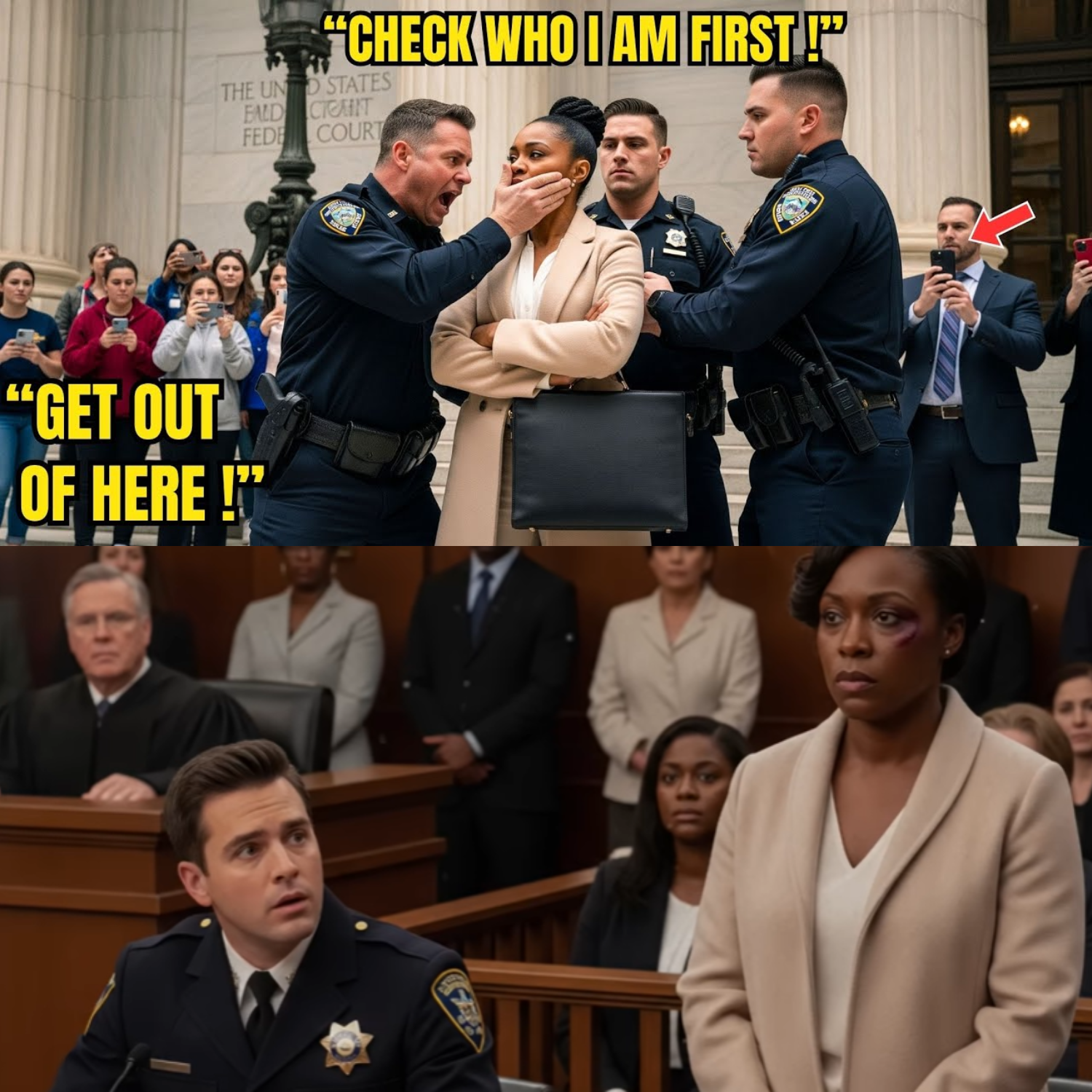
But when Judge Harrison called for the defendant’s statement, Kesha rose slowly, handcuffs clinking. Despite the bruise and disheveled clothes, she carried herself with dignity. “Thank you, your honor.” Her voice was clear, controlled, and filled the room with authority. She calmly cited Supreme Court precedent, explained her legitimate reason for being present, and pointed out the authenticity of her legal documents. When asked her profession, she replied, “Williams. Dr. Williams. And I think we’ll get to my professional background shortly, your honor.”
Kesha methodically dismantled every lie. She requested a preservation order for all surveillance footage, cited the Brady v. Maryland precedent, and noted her scheduled court calendar. She produced her judicial parking pass, building access card, and official identification. The bailiff, Henderson, recognized her and went pale. “Your honor, I believe there’s been a significant misunderstanding about who exactly Officer Martinez assaulted this morning.” She held up her credential wallet, the gold judicial seal gleaming.
Court recessed. In a holding room, Henderson apologized, shocked. Kesha instructed him to fetch her judicial robes and gavel. She called Chief Judge Margaret Carter, ordered all surveillance footage preserved, and asked for every case Martinez had touched in five years to be pulled and reviewed. “A police officer named Martinez just spent an hour testifying under oath about how he heroically subdued a dangerous criminal. The dangerous criminal was me, Margaret. On my way to work, he didn’t just arrest me. He assaulted me in front of this courthouse, called me a filthy animal, and told me I belonged in a cage.”
Ten minutes later, Kesha walked back into the courtroom wearing her black robes with gold trim, her ceremonial gavel in hand. Henderson announced her: “The Honorable Judge Kesha Williams presiding.” The room froze. Martinez went rigid. Judge Harrison fled. Kesha sat behind her bench, her bench, and stared down the man who had brutalized her.
“Officer Martinez, you may remain standing.” Martinez could barely speak. Kesha recited his own words back to him, then played courthouse security footage showing his unprovoked assault, his racist slurs, and the handcuffing. She played backup body cam footage, which Martinez had claimed malfunctioned, revealing even worse language and violence. She called out the other officers who lied under oath, playing their own body cam audio mocking her as “probably just another welfare queen.”
She revealed her identity: the presiding judge for 23 years. Every case Martinez had ever testified in was under her authority. “You saw a black woman and made assumptions. You saw someone you thought was powerless and decided to abuse that power. But Officer Martinez, there’s something else you didn’t know. For six months, I’ve been investigating patterns of misconduct and racial bias in this police department, working directly with the FBI’s civil rights division. This morning’s incident wasn’t random. You’ve been under investigation, and you just provided us with the perfect evidence.”
She dropped the gavel. Martinez collapsed into a chair, his career, reputation, and freedom hanging by a thread. When court resumed, the room was packed. Martinez, now the defendant, faced serious criminal charges. Judge Williams outlined her credentials: Harvard Law, federal prosecutor, civil rights expert, 23 years on the bench, 47 successful prosecutions of police misconduct. She revealed Martinez’s record: 47 complaints, 87% of his arrests were people of color, 63% use of force against those individuals, 40% dismissal rate due to constitutional violations, $2.3 million in settlements paid by the county.
“You took an oath to faithfully and impartially discharge your duties. Not selectively, not based on skin color, not based on your prejudices. What we’re seeing here isn’t just one rogue officer. It’s a system that protects abusers. But today, that system failed you, Officer Martinez, because you assaulted someone who could expose everything.”
She pronounced him guilty of assault in the first degree, assault on a judicial officer, deprivation of civil rights under color of law, and perjury. “You are hereby sentenced to the maximum penalty allowed by law: 25 years in federal prison without parole.” Martinez collapsed, sobbing.
Judge Williams ordered a federal investigation into every case Martinez touched. 432 cases were reopened, dozens of wrongfully convicted defendants were released, hundreds had charges dropped or sentences reduced, and the county paid $8.7 million in compensation. The courthouse was renamed in her honor. Body cameras became mandatory, and all complaints were federally reviewed. The officers who supported Martinez were terminated and charged. The video of Judge Williams delivering her verdict became the most watched courtroom footage in history.
Six months later, Martinez sat in prison, powerless, while the community he once terrorized began to heal. Justice had found its voice, and the whole world saw what happens when courage faces corruption. Sometimes justice wears a blindfold. Sometimes she wears robes. Sometimes she hits back. Never underestimate the power of standing up to bullies. Share this story if you believe everyone deserves justice, no matter who they are or what they look like.
News
Prison Bully Tried to Humiliate the Black Janitor—Ended Up Flat on His Back While the Yard Watched in SHOCK
Prison Bully Tried to Humiliate the Black Janitor—Ended Up Flat on His Back While the Yard Watched in SHOCK The…

“Bikers Unleash Hell on Bullies Who Tormented a Deaf Kid—And Milbrook Will Never Forget”
“Bikers Unleash Hell on Bullies Who Tormented a Deaf Kid—And Milbrook Will Never Forget” The small town of Milbrook, Ohio,…
“Retired Kung Fu Master Snaps Prison Kingpin’s Ego in Half—Chaos Never Saw It Coming”
“Retired Kung Fu Master Snaps Prison Kingpin’s Ego in Half—Chaos Never Saw It Coming” The moment Elias Brooks shuffled into…
“She Crossed Every Line for a Death Row Prisoner—What He Asked Will Make You Question Humanity”
“She Crossed Every Line for a Death Row Prisoner—What He Asked Will Make You Question Humanity” The clang of steel…
“MAGA Veteran HUMILIATES Jamie Raskin With a Savage Line That Will Haunt Him Forever—Congress Gets Schooled on Real Military Values”
“MAGA Veteran HUMILIATES Jamie Raskin With a Savage Line That Will Haunt Him Forever—Congress Gets Schooled on Real Military Values”…
“Racist Cops Slap Cuffs on Black Female General—Her Pentagon Call Nuked Their Careers and Shattered the Department”
“Racist Cops Slap Cuffs on Black Female General—Her Pentagon Call Nuked Their Careers and Shattered the Department” She said, “I’m…
End of content
No more pages to load