
Bank Manager Sets Black Man’s $2.3 Million Check on Fire—Unaware He Just Burned the Owner’s Money, His Career, and the Bank’s Future
Tuesday, 2:47 p.m., First National Bank, downtown Chicago. Marcus Wellington, the branch manager, flicks open his silver lighter with theatrical flair, igniting the $2.3 million business check held by David Williams—a Black man in faded jeans and a gray hoodie—right in the center of the marble lobby. “Your kind doesn’t deserve real money, boy. This fake garbage gets burned,” Wellington declares, holding the flaming check aloft for the crowd before dropping it at David’s feet. The paper erupts in flames, the acrid stench curling up as Wellington grinds the ashes beneath his Italian leather heel. “Look at that,” he boasts to a growing crowd. “Problem solved.”
Phones are out, live streams roll. A blonde woman whispers commentary to her 478 viewers as the security guard approaches, hand on his radio. “Sir, you need to leave,” the guard says. David’s expression remains stone calm. He checks the digital clock—2:48 p.m.—twelve minutes until his board meeting. Have you ever been judged so completely that someone literally burned your worth in front of you?
“Everyone, look at this masterpiece,” Wellington crows, pointing at the smoldering ashes. “Did you see how I handled that fake check? Burned it right in front of him. Problem solved.” Three customers film. The crowd swells. “You walk into my bank wearing clothes from Goodwill with a fake check bigger than most people’s annual salaries. Thought you could fool us? Watch this again.” He grinds his heel into the remaining fragments, pulverizing them into powder. The elderly white customer in her Chanel suit applauds. “Bravo, Marcus,” she calls out. “That’s exactly how you handle their kind. Burn first, ask questions later.” Others nod approvingly.
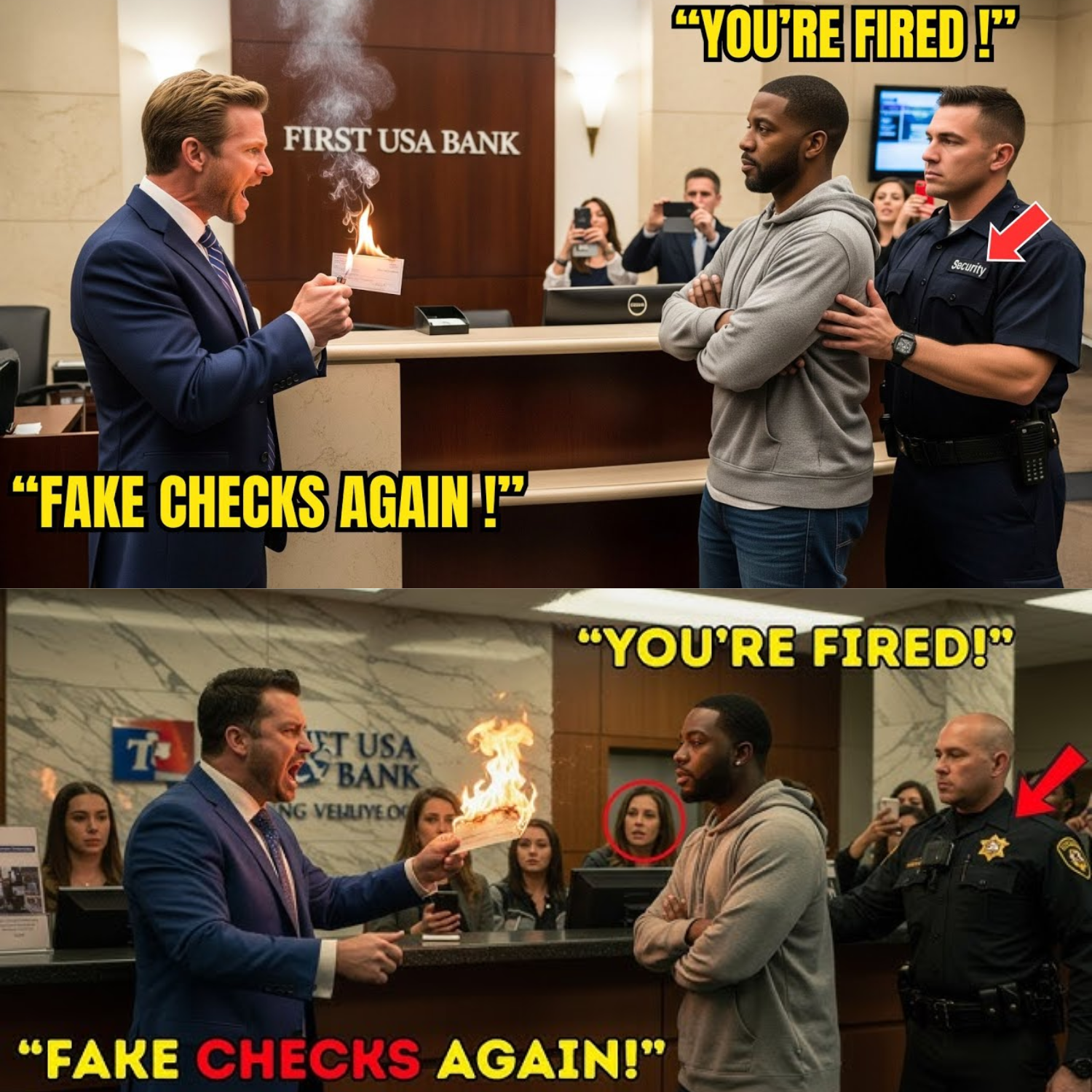
David’s platinum Amex black card peeks from his wallet as he reaches for his ID, but Wellington snatches the wallet first, waving it like a trophy. “Stolen credit cards, too. Ladies and gentlemen, we’ve got ourselves a complete criminal package here. Fake checks, stolen cards, probably fake ID coming next.” Security radios for backup. “Fraud suspect with destroyed evidence and possible stolen property.” David finally speaks, his voice calm: “Mr. Wellington, I’d like my wallet back, please. When the police arrive, you can explain to them where you got it.” Wellington pockets the wallet with a flourish. “And how you managed to forge that check I just had to destroy for evidence preservation.”
The digital clock reads 2:52 p.m. David glances at it. For the first time, observers notice a crack in his composure. “Oh, running late for your next scam?” Wellington sneers. “Don’t worry, you won’t be going anywhere soon. See that pile of ashes? That’s what happens to fraud in Marcus Wellington’s bank.” David’s phone buzzes repeatedly—important calls ignored, drawing Wellington’s attention. “Turn that off. Your accomplices can wait.” The livestream hits 650 viewers; comments explode: “He literally torched it. Boss move of the century. Ashes to ashes, fraud to fraud.” The video is shared across Facebook, Twitter, Instagram. Wellington basks in viral fame, straightening his tie, smoothing his hair. “This is why we maintain strict security protocols. People like this think they can waltz in here with fake paper and fool honest Americans.”
Sarah Mitchell, the assistant manager, shifts uncomfortably. The Chanel customer continues nodding, whispering about finally seeing backbone in customer service. A businessman mutters, “Should have called the cops first, but burning it definitely sends the right message.” Three more customers join the circle, phones out, recording. David’s eyes drift to a first-class boarding pass protruding from his jacket—Chicago to Tokyo, departing tomorrow. Unnoticed by Wellington, who is too busy performing for his audience.
“Sir, please move to the seating area and wait for the authorities,” the security guard instructs. “Actually,” David says, his gaze lingering on the burned remains, “I believe there’s been a significant misunderstanding.” Wellington laughs, ensuring everyone hears. “The only misunderstanding is you thinking a pathetic fake check would work here.” 2:55 p.m. Wellington turns to the crowd. “Burn the fraud, protect the innocent, never let criminals outsmart honest bankers.” The crowd murmurs approval. Phones record the ash pile and David’s composed reaction. David allows the guards to guide him to a leather chair, but something shifts in his expression. He checks his Swiss watch—five minutes until his board meeting begins. The crowd grows hungry.
“Sarah, get over here,” Wellington commands. “You need to witness how real fraud prevention works.” Sarah approaches, her heels clicking against the marble, staring at the ashes, then at David’s calm face. “Take detailed notes for your training file,” Wellington continues, pointing at the charred remains. “This is textbook criminal behavior. Fake check, stolen wallet, probably counterfeit ID. Next, I burned the evidence before he could destroy it or pass it to an accomplice.” The livestream explodes to 1,200 viewers. Comments: “Manager is a legend. Black dude got totally owned. Someone call the FBI.” The blonde woman filming captures both David’s face and the dramatic ash pile.
A second security guard arrives, breathless. “Major fraud attempt in progress,” the first guard says, nodding toward David. “Manager burned the counterfeit check. Suspect carrying stolen credit cards.” Wellington swells with pride. “That was a $2.3 million fraudulent check. Can you believe the audacity?” Teens film, uploading to Instagram: “Bank manager literally burns scammer’s check. Savage manager. #bankburnscheck.” David sits calmly, posture relaxed and confident, checking the time—2:57 p.m., three minutes remaining.
“You seem remarkably calm for someone caught red-handed,” Wellington observes, circling David like a shark. “Most criminals panic when their scam falls apart.” “Do they?” David responds quietly, eyes following Wellington’s theatrics. “Oh, look everyone. He speaks,” Wellington announces. “Enlighten us with your excuses.” The Chanel customer moves closer. “Never witnessed anything like this. Brilliant strategy.” A businessman joins. “You should run for mayor, Marcus. This city needs more backbone.”
David’s phone buzzes—urgent, emergency board meeting starting now. “Turn that device off,” Wellington snaps. “Your partner in crime can wait.” “Actually,” David says, rising, “I need to take this call.” Guards step forward, hands on equipment. “Sit back down,” the first guard orders. Livestream hits 1,500. The woman films: “He’s trying to leave. Scammer attempting escape.” Wellington laughs, gesturing at the ashes. “That pile of carbon was your big meal ticket. Now it’s nothing but humiliation.”
Sarah Mitchell shifts, professional instincts screaming something is wrong. “Marcus, maybe we should verify—” “Verify what?” Wellington cuts her off. “The check is destroyed. The wallet is secured. Case closed.” An impeccably dressed woman enters, pausing at the crowd and the smell of burned paper. “Excuse me, what happened?” “Manager caught a scammer red-handed,” a businessman explains. “Burned his fake check. It’s going viral.” The woman’s eyes widen as she spots David, surrounded by security and a hostile crowd. She films, and Wellington addresses her: “Ma’am, you’re witnessing genuine justice. This individual tried to defraud our institution with a counterfeit instrument.” “$2.3 million,” the Chanel customer adds. “Can you imagine such nerve?”
College students film, uploading to TikTok and Snapchat. David checks his watch—2:58 p.m. His expression shifts, making a critical decision. Livestream comments turn hostile and racially charged: “Lock him up. Typical scammer. At least the fake check got torched. Justice served.” Wellington basks in attention, voice louder and more theatrical. “This is what happens when honest Americans stand up to fraud. We destroy their tools and expose their lies.” The crowd murmurs approval, an echo chamber of validation.
Sarah notices David’s shoes—expensive Italian leather. His watch, genuine Swiss craftsmanship. His confident bearing doesn’t match Wellington’s criminal narrative. “Marcus,” she whispers, “something doesn’t seem right.” “Not now,” Wellington waves her off. David’s phone buzzes one final time. He looks at Wellington, then at the ashes, then finally smiles—genuinely. 2:59 p.m.
“Mr. Wellington,” David says, voice clear and authoritative, “I believe it’s time we had a proper professional conversation.” Wellington laughs, arms wide. “Now he wants to negotiate. Sorry, talking time ended when you tried to pass that counterfeit check.” David reaches into his jacket. Guards tense. He retrieves a simple white business card, placing it gently on the counter beside the ashes. The guard reads it, face turning white.
David Williams, Chairman and CEO, Williams Capital Group.
The livestream woman zooms in, hands shaking. Comments explode: “Wait, what? CEO plot twist. This can’t be happening.” Wellington laughs, desperate. “Anyone can print fake business cards. What’s next, a fake passport?” David retrieves a sleek tablet, opens the First National Bank app, and navigates to the board member portal. He enters his credentials; the screen refreshes:
David Williams, Principal Shareholder, 73% ownership stake. Williams Capital Group Holdings. Position: Chairman of the Board of Directors. Board Member since January 2018. Next scheduled meeting: Tuesday, 3:00 p.m. Emergency session, customer service review. Security clearance: Level 10, full executive access.
The guard’s radio slips from his hand, clattering on the marble. Sarah Mitchell gasps. “Marcus, do you see what that says? Do you understand?” “That’s fake software!” Wellington insists, sweating. “Anyone can create fake screens.” David turns the tablet to the crowd. The livestream captures every pixel. “Guys, this says he owns 73% of the bank. Is this real?” Viewer count explodes past 2,000. Comments: “He owns the bank. Manager is so fired. Best plot twist ever.”
David’s voice cuts through the chaos. “Mr. Wellington, would you like to know what that check you burned actually contained?” Wellington’s face cracks, ego forcing him to double down. “I don’t care what lies you printed. That check was counterfeit.” “It was my quarterly dividend payment,” David states, “from this bank to me as majority shareholder and owner.” Silence falls, even the air conditioning seems to pause. David swipes to another screen: official bank records, security watermarks. Williams Capital Group quarterly dividend, Q4 2024, $2,347,000, authorized by board resolution, issued Tuesday, December 15.
“You just burned $2.3 million of my personal money, Mr. Wellington, on camera, in front of witnesses and thousands watching online.” Wellington turns pale. The wallet feels like a brick in his pocket. “That can’t be,” he stammers. David opens the personnel directory: Marcus Wellington, Branch Manager, Employee ID 4847, Annual salary $127,000, hired March 2018. “You’ve worked for me for six years and eight months, Marcus.”
The Chanel customer backs away. The businessman who wanted Wellington for mayor stares in horror. Teens stand frozen, phones recording. “Did we just watch someone burn their boss’s money?” Livestream explodes past 3,500 viewers. Sarah finds her voice: “Mr. Williams, I am so incredibly sorry. We had no idea who you were.” “Of course you didn’t,” David replies. “I dress casually. I don’t announce my position. Every customer deserves respect, regardless of appearance.”
David stands, surveying the crowd that cheered his humiliation. “This incident wasn’t about procedures. It was about assumptions—about who you thought deserved respect and who didn’t.” Wellington shrinks, suit suddenly too large. “If I had known who you were…” “That’s the problem,” David interrupts. “If you had known who I was. What about who I am as a human being?”
He checks his watch—now two minutes late for the emergency board meeting, called to discuss customer service standards at this branch. “I wonder what we’ll discuss now.” 3:03 p.m. The reckoning begins. David opens the corporate financial dashboard. “First National Bank generated $847 million last year. My investment group contributed $623 million. This branch processes $45 million monthly. Your salary, Marcus, comes from my investment.”
David reads from the employee handbook: “Discrimination by bank personnel violates federal law and corporate policy. Any employee found guilty faces immediate disciplinary action, up to and including termination with cause and forfeiture of benefits.” The Chanel customer edges toward the exit. “Clause 7.88 grants board members—me—the authority to suspend personnel immediately pending investigation. Article 12 requires all discrimination incidents to be permanent record.”
Wellington croaks, “Please, I had no idea…” “But here’s the most significant part,” David says. “Burning a legitimate bank check is a federal crime—mail fraud, destruction of financial documents. Penalties: up to $1 million in fines, 20 years imprisonment.” Livestream explodes past 5,000 viewers. David walks toward Wellington, each step a countdown to judgment.
“Option one: Public apology, sensitivity training, written reprimand, demotion to assistant manager, 40% salary reduction, $50,000 reimbursement to the bank, 200 hours community service.” Wellington nods frantically. “However, given the severity, option one also includes strict probation.” David continues, “Option two: Immediate termination, forfeiture of pension, criminal referral. Your name will be associated with this behavior indefinitely.” David opens the HR system. “I can send termination papers now. Security would escort you out. Your items boxed and mailed.”
Livestream comments: “This is real accountability. Give him option two. Justice in real time.” “There’s a third consideration,” David adds. “The $2.3 million you burned could have funded financial literacy programs, small business loans, scholarships, and community projects. Your prejudice didn’t just hurt me—it damaged the community this bank serves.”
Wellington pleads, “I have a family, children in college…” “One mistake?” David’s voice sharpens. “You made deliberate, calculated choices based on my skin color and your assumptions about my worth.” He gestures to the livestream camera. “You performed your discrimination proudly for an audience. You wanted witnesses. Congratulations. You got exactly what you wanted.”
Security guards stand motionless, uncertain who the real problem is. The burned check fragments tell the story of power reversal. “I need your final decision, Marcus: apology, community service, demotion, probation—or termination and criminal referral. Sixty seconds to choose.” David raises his tablet over the termination paperwork. The clock reads 3:07 p.m. “Choose wisely. This decision will define who you are.”
Wellington’s legs buckle. “I choose option one,” he whispers. “I apologize completely.” “Louder, Marcus. Face the cameras.” Wellington turns to the livestream, pale and drawn. Over 6,000 people watch. “I, Marcus Wellington, sincerely apologize to Mr. David Williams for my discriminatory behavior. I made racist assumptions, destroyed his property, treated him with disrespect. My actions were wrong, illegal, and inexcusable. I accept full responsibility.”
Sarah documents everything. David opens his tablet, navigating to the disciplinary form. “Sarah, prepare Marcus’s new contract: demotion, salary reduction. HR needs documentation within the hour.” “Yes, Mr. Williams.” David announces new protocols: “Dignity First—every customer receives identical service. Respect Monitor—interactions recorded and analyzed by civil rights organizations. Quarterly training for unconscious bias, cultural sensitivity. Community advisory meetings. Anonymous feedback systems. Memorial display in the lobby—the ashes of my check, titled ‘The Cost of Assumptions.’”
Wellington returns David’s wallet. “Thank you, Marcus.” “About your community service: Southside Financial Literacy Center, every Saturday for two years, working with families who look exactly like me. Your first training is this Saturday at 9 a.m. Mrs. Johnson, the center director, will teach you.”
Sarah asks, “Should I notify corporate?” “Already done,” David replies. “Every branch will adopt these standards within 90 days.” Livestream viewers realize they’ve witnessed systemic change born from one man’s prejudice and another’s dignity. Comments: “This is how you fix racism. Policy change in real time.”
David turns to the crowd. “What happened today wasn’t just about me or Marcus. It was about the assumptions we make, the respect we deny, and the changes we create when we choose justice over revenge.” He holds up the ashes. “These represent $2.3 million, but more importantly, the cost of prejudice. Tomorrow, they’ll be the foundation of something better.”
In 12 minutes, humiliation became education, discrimination became reform, pain became healing. Wellington stands quietly, career in ashes but hope for redemption through change. “Any questions, Marcus?” “No, sir. Thank you for the second chance.” “Don’t thank me yet. Thank me in two years when you see people as humans, not assumptions.”
Six months later, the memorial display draws visitors nationwide. Wellington arrives early at the Southside Center, helping families he once viewed with suspicion. “Morning, Mrs. Johnson.” “Morning, Marcus. The Rodriguez family is waiting. Their loan was denied—help them understand why.” Wellington’s transformation required confronting bias one conversation at a time.
The viral video reaches 15 million views. #BankBurnsCheck becomes a movement. Universities use the case study. Companies adopt David’s protocols. Williams Capital Group’s approach becomes industry standard. Customer satisfaction rises. Other banks follow suit.
Wellington’s journey: from burning checks in arrogance to explaining loan requirements with empathy. His 200 hours became 600, the requirement ended but the learning continues. “I was wrong,” he admits. “Success means including people.” David nods. “Wisdom can’t be taught. It’s earned.”
The memorial’s message: Children ask about the ashes. Adults share stories. The display includes a QR code for resources. Educational materials explain how assumptions become exclusion. “Those ashes represent every time someone’s worth was judged by appearance,” David says. “Every time potential was dismissed by prejudice.”
Systemic change ripples outward. The Williams standards spread across industries. Businesses see measurable improvements. Technology companies develop bias detection software. David doesn’t consider himself a hero. “I refused to let prejudice stand unchallenged. The real heroes are those who choose to grow.”
David’s dividend checks still arrive at the branch, now processed with respect. He visits unannounced, ensuring standards remain high. The Tokyo boarding pass led to a business expansion creating 200 jobs in underserved communities. His calm response created opportunities anger never could.
The lesson: Change doesn’t require violence or wealth, but courage to stand for principles, wisdom to choose education over retaliation, and commitment to systems that protect dignity. Share your story. Every act of dignity builds bridges. #FireproofWorth becomes a rallying cry.
Remember: They can burn your check, but never your worth. When you own the power to create change, justice looks like education, not revenge. The ashes aren’t just remnants—they’re fertilizer for growth. From destruction comes creation. From humiliation comes education. From pain comes healing. That’s how you turn a burned check into a burned bridge to discrimination.
The End.
News
Prison Bully Tried to Humiliate the Black Janitor—Ended Up Flat on His Back While the Yard Watched in SHOCK
Prison Bully Tried to Humiliate the Black Janitor—Ended Up Flat on His Back While the Yard Watched in SHOCK The…

“Bikers Unleash Hell on Bullies Who Tormented a Deaf Kid—And Milbrook Will Never Forget”
“Bikers Unleash Hell on Bullies Who Tormented a Deaf Kid—And Milbrook Will Never Forget” The small town of Milbrook, Ohio,…
“Retired Kung Fu Master Snaps Prison Kingpin’s Ego in Half—Chaos Never Saw It Coming”
“Retired Kung Fu Master Snaps Prison Kingpin’s Ego in Half—Chaos Never Saw It Coming” The moment Elias Brooks shuffled into…

“She Crossed Every Line for a Death Row Prisoner—What He Asked Will Make You Question Humanity”
“She Crossed Every Line for a Death Row Prisoner—What He Asked Will Make You Question Humanity” The clang of steel…
“MAGA Veteran HUMILIATES Jamie Raskin With a Savage Line That Will Haunt Him Forever—Congress Gets Schooled on Real Military Values”
“MAGA Veteran HUMILIATES Jamie Raskin With a Savage Line That Will Haunt Him Forever—Congress Gets Schooled on Real Military Values”…
“Racist Cops Slap Cuffs on Black Female General—Her Pentagon Call Nuked Their Careers and Shattered the Department”
“Racist Cops Slap Cuffs on Black Female General—Her Pentagon Call Nuked Their Careers and Shattered the Department” She said, “I’m…
End of content
No more pages to load