
“Billionaire CEO HUMILIATED in Court: Judge Caprio SHREDS Arrogant Tycoon Who Flipped Off Justice—Epic Downfall Caught on Camera!”
In the marble halls of Providence Municipal Court, a spectacle unfolded that would send shockwaves through the world of corporate power and public justice. It was a clash not just of wealth and law, but of arrogance and humility—a story that began with a parking ticket but ended with the richest CEO in Rhode Island crawling out of court, reputation in tatters, after daring to give Judge Frank Caprio the middle finger.
The man at the center of this firestorm was none other than Alexander “Lex” Harrington, CEO of Harrington Holdings—a global conglomerate with fingers in tech, real estate, and luxury goods. Harrington’s net worth hovered around $4.2 billion, his face a regular fixture in business magazines and Forbes lists. He was the type who arrived everywhere with an entourage, his suits tailored in Milan, his watch worth more than most people’s houses. But on this fateful Tuesday morning, Harrington was just another name on the docket, charged with a series of traffic violations—including a $250 parking ticket for blocking a handicap ramp outside a children’s hospital.
The courtroom was packed. Journalists had gotten wind of Harrington’s appearance, and the air buzzed with anticipation. Judge Frank Caprio, renowned for his compassion and fairness, presided over the bench with his usual calm presence. But even Caprio couldn’t have predicted the storm that was about to hit.
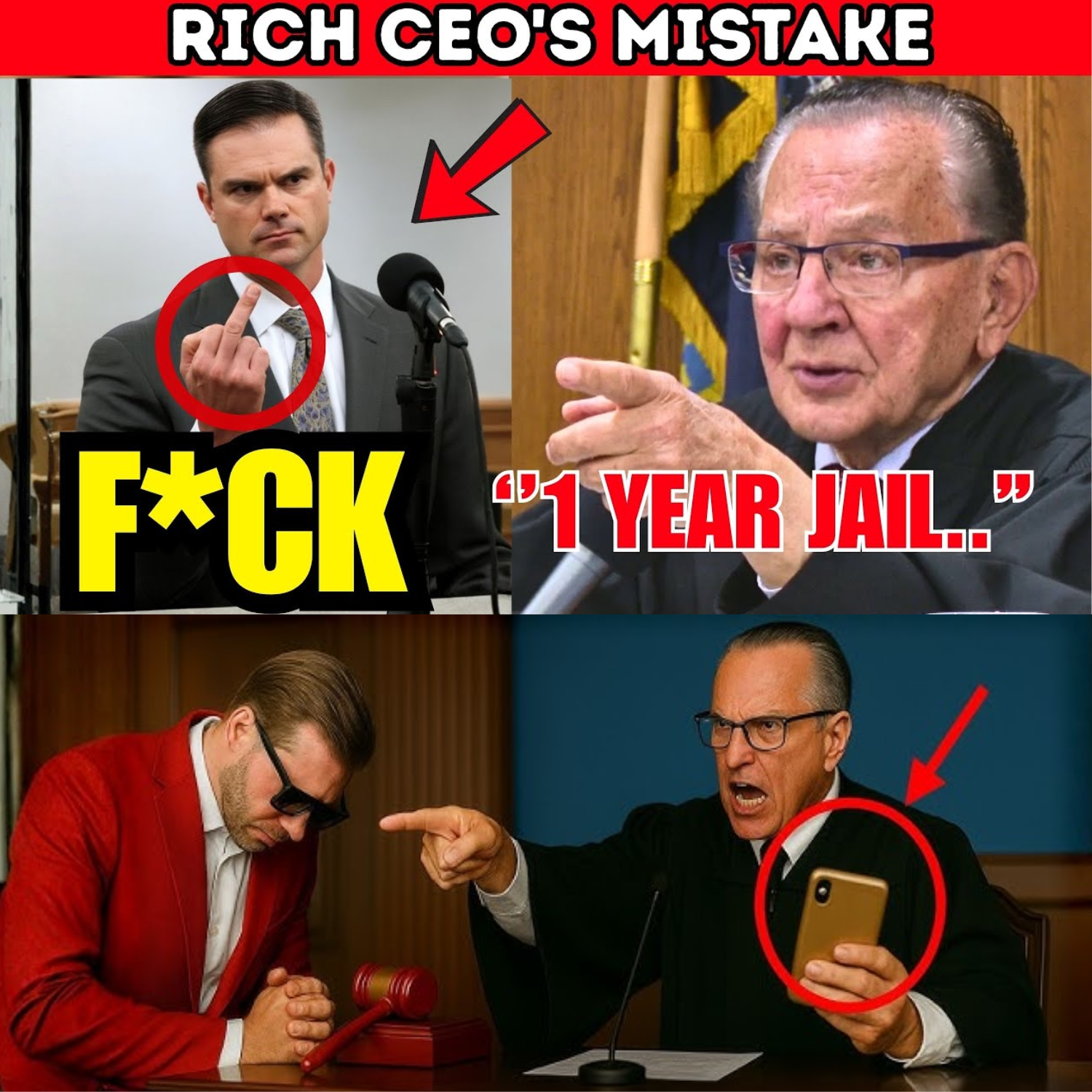
Harrington swaggered to the defendant’s table, flanked by two lawyers in pinstriped suits. He wore sunglasses indoors, a diamond cufflink glinting as he flicked his wrist. The bailiff read out the charges: illegal parking, reckless driving, and obstruction of a handicap ramp. Each violation carried hefty fines, but for Harrington, the amounts were pocket change. He barely glanced at the paperwork, his attention fixed on his phone.
“Mr. Harrington,” Judge Caprio began, “you are charged with blocking a handicap ramp outside St. Mary’s Children’s Hospital. How do you plead?”
Harrington didn’t look up. “Guilty, I guess. Can we hurry this up? I have a meeting with the governor in fifteen minutes.”
A murmur rippled through the gallery. Caprio’s eyes narrowed ever so slightly. “You guess? Mr. Harrington, this is a court of law. You either plead guilty or not guilty.”
Harrington finally looked up, removing his sunglasses with an exaggerated sigh. “Fine. Guilty. Whatever. Can we just pay and leave?”
Caprio’s tone remained measured. “Blocking a handicap ramp is a serious offense. That ramp provides access for children in wheelchairs. Did you realize the consequences of your actions?”
Harrington smirked. “Listen, Judge, I parked there for five minutes. My driver was right outside. No harm done. If the city wants more money, just tell me how much. I’ll write a check right now.”
The arrogance was palpable. Caprio glanced at the lawyers, who shifted uncomfortably. “Mr. Harrington, the law applies to everyone equally, regardless of wealth.”
Harrington leaned back, arms crossed. “I’m not here for a lecture. I’m here to pay a fine. You want to make an example of me, go ahead. I’ll double the payment. Triple it. Just don’t waste my time.”
At this, Judge Caprio paused. The courtroom fell silent. “Mr. Harrington, do you believe your wealth exempts you from responsibility?”
Harrington rolled his eyes. “Honestly, yes. I pay more taxes in a week than most people make in a year. I fund charities, hospitals, schools. If I want to park somewhere for five minutes, I should be able to.”
The tension was electric. Caprio leaned forward. “Mr. Harrington, you are not above the law. The rules exist to protect the vulnerable, not to inconvenience the powerful.”
Harrington scoffed, then—whether out of frustration or pure contempt—he made a gesture so brazen it would become infamous: he raised his hand, extended his middle finger, and pointed it directly at Judge Caprio. The gallery gasped. The bailiff stepped forward. The lawyers froze.
Caprio’s face remained impassive, but his voice was icy. “Mr. Harrington, did you just make an obscene gesture toward this court?”
Harrington shrugged. “Maybe. Maybe not. Who cares?”
The room was stunned. Caprio picked up his gavel, but didn’t use it. Instead, he addressed the bailiff. “Bailiff, please record Mr. Harrington’s behavior for the record. I am holding him in contempt of court.”
Harrington laughed. “Contempt? For a finger? This is a joke. I’ll pay whatever you want. Just tell me the number.”
But Caprio wasn’t finished. “Mr. Harrington, your actions have consequences. Not only have you shown disregard for the law, you have insulted this court, the people of Providence, and the children who rely on that handicap ramp. You will not buy your way out of accountability today.”
Harrington’s lawyers scrambled, whispering frantically. One stood. “Your honor, my client apologizes for any perceived disrespect. He’s under a great deal of stress—”
Caprio cut him off. “Stress does not excuse contempt. Mr. Harrington, you are fined $5,000 for contempt of court, in addition to the $250 for the parking violation and $500 for obstruction. Furthermore, you are ordered to perform 100 hours of community service at St. Mary’s Children’s Hospital—specifically assisting children with mobility challenges. You will report weekly to this court, and failure to comply will result in jail time.”
Harrington’s jaw dropped. “You can’t be serious.”
“I am entirely serious,” Caprio replied. “You have 30 days to begin your service. Court is adjourned.”
The gavel fell, echoing through the stunned courtroom. Harrington stood, mouth agape, as reporters snapped photos and the gallery erupted in whispers. His lawyers rushed to his side, but the damage was done. The richest man in Rhode Island had been publicly humiliated, his arrogance shattered by a judge who refused to be bought.
The fallout was immediate. News outlets ran the story with relish—“Billionaire CEO Gets Schooled by Judge Caprio!” “Lex Harrington Flips Off Justice, Gets Destroyed!” Social media exploded with memes of Harrington’s middle finger and Caprio’s stern face. The hashtag #CaprioJustice trended nationwide.
But the humiliation didn’t end in the courtroom. Harrington’s board of directors called an emergency meeting. Investors panicked as the viral video circulated. Sponsors withdrew from Harrington Holdings’ charity events, citing “unacceptable behavior.” Employees whispered about the CEO’s downfall. The company’s stock dipped, and Harrington was forced to issue a public apology: “I deeply regret my actions in court. I respect the law and the community, and I will fulfill all obligations as ordered by Judge Caprio.”
Yet even the apology couldn’t erase the image of a billionaire reduced to a lesson in humility. The following week, Harrington arrived at St. Mary’s Children’s Hospital—no entourage, no sunglasses, just a plain shirt and jeans. He wheeled children to therapy, cleaned ramps, and listened to parents’ stories. At first, he was met with suspicion and resentment. But as the weeks passed, something changed. Harrington began to understand the struggles of families whose lives revolved around wheelchairs and hospital corridors. He donated new equipment, funded a playground for disabled children, and quietly paid medical bills for families in crisis.
Judge Caprio monitored Harrington’s progress, requiring weekly reports. When Harrington completed his 100 hours, Caprio called him back to court. “Mr. Harrington, have you learned anything from your experience?”
Harrington nodded, his arrogance gone. “I learned that money can’t buy respect. That the law protects those who need it most. And that sometimes, the most valuable lesson comes from being held accountable.”
Caprio smiled. “That is the purpose of justice. You are dismissed.”
The story became legend. Alexander Harrington’s downfall and redemption were discussed in business schools, ethics seminars, and boardrooms across America. Judge Caprio’s refusal to bend to wealth sent a message: in Providence, justice is blind—even to billionaires.
The toxic arrogance that led Harrington to flip off the judge became a cautionary tale, a viral reminder that no one, no matter how powerful, is above the law. And in a world often dominated by money and influence, it was a victory for compassion, accountability, and the dignity of those most often overlooked.
So next time you think you can buy your way out of trouble, remember: Judge Caprio is watching. And justice has a way of flipping the script—no matter who you are.
For more epic courtroom showdowns, subscribe to Order in the Court. Because sometimes, the law isn’t just about fines—it’s about making the arrogant fall, and the humble rise.
News

Prison Bully Tried to Humiliate the Black Janitor—Ended Up Flat on His Back While the Yard Watched in SHOCK
Prison Bully Tried to Humiliate the Black Janitor—Ended Up Flat on His Back While the Yard Watched in SHOCK The…

“Bikers Unleash Hell on Bullies Who Tormented a Deaf Kid—And Milbrook Will Never Forget”
“Bikers Unleash Hell on Bullies Who Tormented a Deaf Kid—And Milbrook Will Never Forget” The small town of Milbrook, Ohio,…
“Retired Kung Fu Master Snaps Prison Kingpin’s Ego in Half—Chaos Never Saw It Coming”
“Retired Kung Fu Master Snaps Prison Kingpin’s Ego in Half—Chaos Never Saw It Coming” The moment Elias Brooks shuffled into…

“She Crossed Every Line for a Death Row Prisoner—What He Asked Will Make You Question Humanity”
“She Crossed Every Line for a Death Row Prisoner—What He Asked Will Make You Question Humanity” The clang of steel…
“MAGA Veteran HUMILIATES Jamie Raskin With a Savage Line That Will Haunt Him Forever—Congress Gets Schooled on Real Military Values”
“MAGA Veteran HUMILIATES Jamie Raskin With a Savage Line That Will Haunt Him Forever—Congress Gets Schooled on Real Military Values”…

“Racist Cops Slap Cuffs on Black Female General—Her Pentagon Call Nuked Their Careers and Shattered the Department”
“Racist Cops Slap Cuffs on Black Female General—Her Pentagon Call Nuked Their Careers and Shattered the Department” She said, “I’m…
End of content
No more pages to load